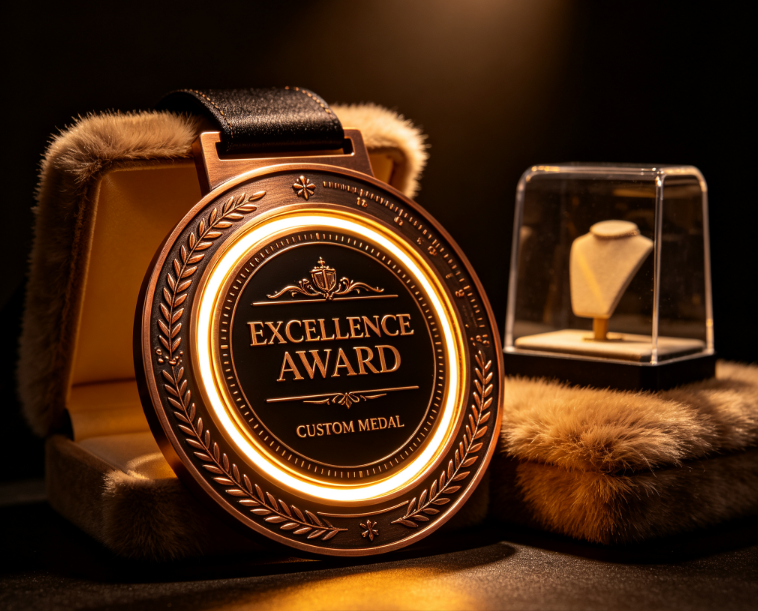
A custom medal with LED light combines traditional metal recognition with modern electronic lighting. This type of award can create a stronger visual impact than a conventional medal, especially for night races, esports competitions, anniversary events, military ceremonies, corporate awards, music festivals and premium promotional programs.
However, adding an LED system changes the project from a purely metal-product order into a metal + electronics + assembly project. Buyers need to consider battery type, LED position, switch design, PCB space, waterproofing, weight, safety, packaging and production testing before approving the final design.
This guide explains the major design options, manufacturing considerations, cost factors, applications and quality-control points for LED medals.
1. What Is a Custom LED Medal?
A custom LED medal is a recognition medal that incorporates one or more light-emitting components.
A typical structure may include:
- Custom metal body
- LED module
- Battery
- Switch
- Wiring or PCB
- Acrylic or translucent insert
- Enamel
- Plating
- Ribbon
- Back cover
The metal portion provides the traditional premium appearance, while the LED creates a visual effect.
2. Why Add LED Lighting to a Medal?
LED lighting can make a medal:
- More memorable
- More interactive
- More visible at night
- More suitable for photography
- More attractive to younger audiences
- More distinctive from standard medals
This is particularly useful when the medal itself is intended to become part of the event experience.
3. Main Applications
Custom LED medals can be used for:
Running Events
Night races, marathons and fun runs.
Cycling Events
Night cycling competitions and cycling festivals.
Esports
Championship and tournament awards.
Music Festivals
VIP recognition and commemorative awards.
Corporate Events
Employee recognition and milestone awards.
Military Ceremonies
Special commemorative awards and anniversary events.
School Events
Graduation and achievement awards.
Charity Events
Fundraising walks and nighttime events.
Theme Parks
Special event souvenirs.
Brand Promotions
Limited-edition promotional recognition products.
4. LED Medal Design Possibilities
The lighting does not have to illuminate the entire medal.
Common approaches include:
- Illuminated logo
- Illuminated text
- Illuminated center
- Illuminated border
- Backlighting
- Edge lighting
- Flashing LED
- Color-changing LED
- Multi-zone lighting
The best approach depends on the artwork.
5. Illuminated Center Design
One of the simplest designs is a central illuminated area.
For example:
Metal border → translucent center → LED behind center
The center can display:
- Event logo
- Number
- Year
- Organization emblem
- Character
- Symbol
This design provides a strong visual contrast.
6. Illuminated Logo
A company or event logo can be designed as the illuminated focal point.
A typical structure could be:
Metal outline + translucent logo + LED
This works particularly well for:
- Corporate awards
- Brand events
- Product launches
- Anniversary medals
7. LED Text
Text can also be illuminated.
Examples include:
FINISHER
CHAMPION
2026
NIGHT RUN
However, very small lettering may not provide enough space for the LED components.
8. LED Border
An LED strip or segmented LED arrangement can be installed around the medal perimeter.
This can create a glowing outline.
It is particularly effective for:
- Night races
- Music festivals
- Esports
- Entertainment events
9. Backlit Medal Design
A translucent insert can be positioned above an LED module.
When the LED turns on, the light passes through the insert.
This can produce a:
glowing emblem effect
without exposing the LED directly.
10. Edge-Lit Acrylic
Acrylic is useful for light transmission.
A common structure is:
LED → acrylic edge → engraved or printed graphic
The acrylic distributes light through the material.
This can create a premium illuminated appearance while maintaining a relatively clean front surface.
11. Metal + Acrylic + LED Construction
A three-layer structure is often useful:
Front
Metal decorative frame
Middle
Acrylic or translucent insert
Back
LED and battery module
This allows the medal to retain a substantial metal appearance while providing a lighting effect.
12. Choosing the Metal
Potential materials include:
- Brass
- Copper
- Zinc alloy
- Iron
- Stainless steel
Zinc alloy can be particularly useful for complex decorative shapes.
Brass and copper can be suitable when a traditional die-struck appearance is desired.
13. Why Zinc Alloy Can Be Useful
Zinc alloy allows relatively complex shapes and relief structures.
It can be suitable for:
- 3D medals
- Irregular outlines
- Large center openings
- Decorative frames
- Integrated LED windows
The final material choice should depend on the actual engineering design.
14. Medal Size
LED medals may require additional internal space.
Common medal sizes might include:
- 2.5 inches
- 3 inches
- 3.5 inches
- 4 inches
- Larger custom dimensions
The larger the medal, the more room there may be for:
- Battery
- PCB
- LED
- Wiring
- Switch
15. Why Size Matters More for LED Medals
A conventional metal medal can be relatively thin.
An LED medal needs internal space for electronic components.
Therefore, the engineering team must consider:
Visual thickness vs functional thickness
The medal should look substantial without becoming unnecessarily heavy.
16. Medal Thickness
Traditional medals may use different thicknesses depending on their design.
For an LED medal, additional thickness may be needed for:
- LED module
- Battery
- Wiring
- PCB
- Back cover
Therefore, the thickness cannot be selected only from the front artwork.
17. Battery Selection
Battery selection is one of the most important engineering decisions.
Possible options include:
Coin-cell battery
Compact and convenient for smaller LED systems.
Rechargeable battery
Suitable when repeated use is required.
AAA/AA battery
Larger but easy to replace.
The appropriate battery depends on:
- LED count
- Brightness
- Operating time
- Medal size
- Weight
- Intended use
18. Battery Life
Battery life depends on:
Battery capacity + LED power consumption + circuit design + usage mode
For example, a medal that only lights for several minutes during a ceremony has very different requirements from a medal intended to glow for several hours.
Therefore, specify:
“Required continuous lighting time”
before finalizing the electronics.
19. Push Button Design
A simple push button can activate the LED.
Possible modes:
Press once → ON
Press again → OFF
Another design can use:
Press → ON
Press → Flash
Press → OFF
20. Hidden Switch
The switch can be integrated into:
- Back of medal
- Side edge
- Ribbon attachment area
- Rear cover
A hidden switch creates a cleaner appearance.
21. Pull-Tab Battery Activation
For event distribution, a pull-tab can prevent battery drain during storage.
The recipient removes the tab before use.
This can be useful for:
- Race medals
- Event awards
- Promotional products
22. Flashing LED
Instead of continuous illumination, the LED can flash.
This can:
- Reduce power consumption
- Create a stronger visual effect
- Increase attention
Flashing patterns can be programmed depending on the electronic system.
23. Multi-Color LED
LED medals can use:
- Red
- Green
- Blue
- White
- RGB
RGB systems can create multiple colors.
However, additional electronics may increase:
- Cost
- Engineering complexity
- Battery consumption
24. White LED
White LEDs are useful when the objective is to illuminate:
- Logos
- Numbers
- Text
- Translucent acrylic
White light can provide a clean appearance.
25. RGB LED
RGB LEDs can create changing colors.
This is especially attractive for:
- Esports
- Music festivals
- Night races
- Entertainment events
The buyer should specify whether the color is:
- Fixed
- Alternating
- Flashing
- Programmable
26. LED Placement
LEDs can be placed:
- Behind the center
- Around the perimeter
- Along acrylic edges
- Behind lettering
- Behind logos
- At multiple points
LED placement must be determined during engineering.
27. Light Diffusion
Direct LED light can create bright spots.
A diffuser can help create more uniform illumination.
Potential materials include:
- Frosted acrylic
- Diffusing plastic
- Translucent resin
This is particularly important for large illuminated surfaces.
28. Avoiding Hot Spots
A hot spot occurs when one area appears much brighter than another.
Possible solutions include:
- Increasing diffusion distance
- Adding diffuser material
- Adjusting LED positions
- Using multiple lower-intensity LEDs
The final design should be tested before mass production.
29. Metal and Light Transmission
Metal itself does not transmit light.
Therefore, illuminated areas usually require:
- Cut-outs
- Acrylic
- Resin
- Translucent plastic
- Thin light-transmitting sections
This needs to be considered during the original artwork stage.
30. Enamel and LED Effects
Enamel can be combined with LED illumination.
For example:
Metal border + soft enamel + illuminated center
However, enamel areas should not unintentionally block the intended light path.
31. Soft Enamel vs Hard Enamel
Soft Enamel
Recessed surface.
Hard Enamel
Smooth polished surface.
For illuminated sections, transparent or translucent materials may be more suitable than conventional opaque enamel.
32. Transparent Enamel
Transparent color can allow some light to pass through.
This can create:
Colored glowing areas
instead of simply white illumination.
33. 3D LED Medals
A 3D relief can be combined with LED lighting.
For example:
- Raised eagle
- Illuminated shield
- 3D trophy
- Raised event logo
The engineering challenge is ensuring that the 3D relief does not block the light path.
34. Cut-Out LED Medals
A medal can contain deliberate openings.
The openings can form:
- Stars
- Letters
- Numbers
- Logos
- Geometric patterns
LED light can pass through these openings.
35. Multi-Layer LED Medals
A premium medal may use several layers:
Layer 1: Decorative metal
Layer 2: Acrylic
Layer 3: LED circuit
Layer 4: Battery compartment
This provides more design freedom but increases assembly complexity.
36. LED Medal Weight
Weight depends on:
- Metal area
- Metal thickness
- Battery
- PCB
- LED count
- Acrylic
- Back cover
A large metal medal with electronics can become significantly heavier than a conventional medal.
37. Why Weight Matters
For a running event, the medal may be worn around the neck.
Therefore:
Weight + ribbon width + medal size
should be evaluated together.
A heavy LED medal may look impressive but may be uncomfortable during long events.
38. LED Medal for Running Events
For running medals, consider:
- Lightweight construction
- Secure ribbon attachment
- Protected electronics
- Easy activation
- Good visibility
- Comfortable weight
Night races are especially suitable for illuminated medals.
39. LED Medal for Esports
Esports awards can use:
- RGB LEDs
- Team colors
- Illuminated logos
- Gaming symbols
- Dynamic lighting
This can create a more contemporary appearance than a traditional medal.
40. LED Medal for Military Applications
Potential applications include:
- Unit anniversaries
- Special commemorations
- Retirement events
- Military competitions
- Training graduations
- Recognition programs
For military projects, the design should preserve clear unit identity while using lighting as an enhancement.
41. LED Medal for Police Events
Police organizations can use illuminated medals for:
- Anniversary events
- Recognition ceremonies
- Awards
- Department celebrations
- Special commemorations
The badge or department emblem can become the illuminated centerpiece.
42. LED Medal for Firefighter Events
Firefighter medals can incorporate:
- Helmet
- Maltese cross
- Fire truck
- Department emblem
- Flame motif
A glowing flame element can be especially effective.
43. LED Medal for Corporate Events
Corporate LED medals can use:
- Company logo
- Brand colors
- Anniversary year
- Employee achievement
- Product launch identity
LED lighting can help create a more premium award experience.
44. LED Medal for School Events
Potential applications include:
- Graduation
- Robotics competitions
- Science fairs
- Sports championships
- Academic awards
RGB lighting may work especially well for student-focused events.
45. LED Medal for Charity Events
Charity night walks and fundraising events are strong candidates.
The medal can include:
Event logo + illuminated ribbon + year
This can make the award more visible after dark.
46. LED Medal for Night Races
Night running is one of the strongest applications.
The medal can:
- Glow
- Flash
- Display the event logo
- Create a photo-friendly effect
It can become part of the participant experience rather than simply an award.
47. Waterproofing Considerations
If the medal is intended for outdoor events, water exposure should be considered.
Potential exposure includes:
- Rain
- Sweat
- Humidity
- Condensation
Electronics need appropriate protection based on the expected environment.
Do not assume a decorative LED medal is waterproof simply because the metal exterior is resistant to corrosion.
48. Water-Resistance Testing
For outdoor applications, discuss:
- Splash resistance
- Moisture protection
- Battery compartment sealing
- Connector protection
The required protection level should be defined by the actual application.
49. Heat Management
LED components generally generate less heat than many traditional lighting technologies, but electronics still require appropriate design.
The manufacturer should ensure that:
- Components operate within specification
- Battery temperature remains appropriate
- The enclosure does not create unsafe heat accumulation
50. Battery Safety
Battery-powered products require appropriate engineering.
Important considerations include:
- Correct battery type
- Correct polarity
- Secure battery holder
- Protection against short circuits
- Appropriate insulation
- Safe assembly
For larger commercial projects, applicable product and shipping regulations should be reviewed.
51. LED Medal Shipping
Battery-powered products may have additional shipping considerations depending on the battery type and transportation method.
Before shipment, confirm:
- Battery type
- Battery installation status
- Packaging requirements
- Carrier restrictions
- Destination regulations
52. Packaging for LED Medals
LED medals require packaging that protects:
- Metal surface
- Acrylic
- LEDs
- Switch
- Battery
- Ribbon
Individual packaging can reduce scratches and accidental activation.
53. Pull-Tab Packaging
A battery isolation tab can be useful during shipping and storage.
It prevents accidental activation.
This can be especially useful for orders involving thousands of medals.
54. LED Medal Cost Structure
A basic cost model is:
Metal body
Tooling
LED module
Battery
Acrylic/translucent component
Assembly
Finishing
Packaging
Shipping
The electronic components make LED medals more complex than conventional medals.
55. Example Cost Analysis
Consider a hypothetical 1,000-piece order:
| Component | Example Cost |
|---|---|
| Metal medal | $1.80 |
| LED module | $0.45 |
| Battery | $0.20 |
| Acrylic insert | $0.25 |
| Assembly | $0.30 |
| Packaging | $0.20 |
| Example production cost | $3.20 |
These numbers are illustrative only, not a market quotation.
56. Why LED Count Matters
One LED may be sufficient for a small center logo.
A larger illuminated perimeter could require multiple LEDs.
More LEDs can increase:
- Component cost
- Assembly time
- Battery consumption
- Circuit complexity
57. Why Battery Size Matters
Higher-capacity batteries can increase:
- Weight
- Thickness
- Cost
But they may provide longer operating time.
The correct balance depends on how long the medal needs to illuminate.
58. LED Operating Time
Before ordering, specify:
Required illumination time per activation
For example:
- 5 minutes
- 30 minutes
- 1 hour
- Several hours
This directly influences electronics selection.
59. Continuous vs Intermittent Use
A medal used for:
30 seconds during a ceremony
has different power requirements from one used:
for several hours during a festival.
This should be established before engineering.
60. Assembly Complexity
A conventional medal may require relatively straightforward assembly.
An LED medal can require:
Metal + acrylic + PCB + LED + battery + switch + back cover
Therefore, assembly quality becomes an important production consideration.
61. Wiring
Wires should be:
- Properly insulated
- Correctly positioned
- Securely attached
- Protected from sharp metal edges
Poor wiring can cause intermittent lighting or complete failure.
62. PCB Design
A small PCB can control:
- LED activation
- Flashing
- Color changing
- Timing
- Power management
For advanced LED medals, PCB design should be included in the engineering process.
63. Simple vs Programmable LED Systems
Simple System
ON/OFF.
Lower complexity.
Programmable System
Multiple lighting modes.
Higher complexity.
For most standard event medals, a simple system may be sufficient.
64. Sound + LED Medal
In some advanced promotional products, LEDs may be combined with sound modules.
This can create:
- Music
- Voice
- Sound effects
However, this significantly increases:
- Electronics complexity
- Battery requirements
- Cost
- Testing
65. NFC/RFID + LED
Advanced commemorative products can potentially combine electronics with:
- NFC
- RFID
- Digital authentication
The medal then becomes more than a physical award.
However, these technologies should be considered only when there is a clear application requirement.
66. QR Code + LED Medal
A QR code can be incorporated into the design or packaging.
It can link to:
- Event results
- Photos
- Registration page
- Organization website
- Digital certificate
The QR code itself does not necessarily need to be illuminated.
67. NFC + Recognition Medal
An NFC-enabled medal could connect users to digital content.
Potential applications:
- Digital award certificates
- Event history
- Participant profile
- Membership information
This is particularly interesting for premium events.
68. LED Medal Durability
Durability depends on:
- Metal construction
- Component protection
- Battery holder
- Switch quality
- Acrylic strength
- Assembly
A visually attractive prototype is not automatically a durable production product.
69. Drop Testing
For medals that will be transported and worn, manufacturers can consider controlled drop testing.
The goal is to evaluate:
- Acrylic cracking
- Component movement
- Battery displacement
- LED failure
- Surface damage
Testing requirements should be agreed upon in advance.
70. Pull Testing for Ribbon Attachment
The ribbon attachment point is important.
The medal should withstand normal wearing forces.
For large or heavy LED medals, the attachment system may require reinforcement.
71. Surface Protection
LED medals can use:
- Protective film
- Individual poly bags
- Foam
- Custom inserts
to reduce scratching during transportation.
72. Scratch Risk
Glossy plating and acrylic surfaces can show scratches more easily.
Packaging should prevent:
Metal-to-metal contact
and:
Metal-to-acrylic contact
during shipping.
73. Color Consistency
If RGB or colored translucent components are used, color consistency should be checked.
The manufacturer should define:
- LED color
- Acrylic color
- Enamel color
- Plating color
before production.
74. Lighting Uniformity
Quality control should check whether:
- Center illumination is even
- LEDs are functioning
- No LED is excessively bright
- No area remains unintentionally dark
This can be performed during assembly testing.
75. Mass Production Testing
For 1,000+ pieces, every LED system should ideally be tested according to an agreed QC procedure.
Possible checks include:
LED ON
LED OFF
Switch operation
Battery connection
Visual inspection
76. 100% Functional Testing
For electronics, buyers may request 100% functional testing.
This means each finished medal is checked for basic operation.
For high-volume products, the additional inspection cost should be included in the quotation.
77. Sampling Inspection
Another approach is statistical sampling.
The exact percentage should be agreed with the manufacturer.
Critical projects may justify a more rigorous inspection plan.
78. LED Medal Tooling
Tooling may include:
- Metal die
- Acrylic mold/cutting fixture
- Electronic fixture
- Assembly tooling
The tooling requirements depend heavily on the construction.
79. Engineering Before Tooling
Before opening the metal mold, confirm:
- LED location
- Battery location
- Switch location
- Back cover
- Wiring
- Acrylic dimensions
- Ribbon attachment
Changing these after tooling can increase cost and delay.
80. Digital Mockup
A digital 3D mockup can show:
- Front
- Back
- Side
- Thickness
- LED window
- Ribbon
This allows engineering problems to be identified earlier.
81. Prototype Stage
For a complex LED medal, prototype production can be valuable.
Prototype objectives include:
- Confirm appearance
- Test lighting
- Test weight
- Test battery
- Test switch
- Check assembly
Only after these are satisfactory should mass production begin.
82. Why Prototyping Saves Money
A prototype may cost more per piece.
But it can prevent a large-scale problem.
For example:
1 prototype
can reveal an issue before:
5,000 units
are manufactured.
83. LED Medal Production Workflow
A typical workflow is:
Artwork
↓
3D engineering
↓
Digital proof
↓
Prototype
↓
Metal tooling
↓
Metal production
↓
Surface finishing
↓
Acrylic production
↓
Electronics assembly
↓
LED testing
↓
Final QC
↓
Packaging
↓
Shipping
84. Production Lead Time
A relatively simple LED medal may require approximately:
20–30 production days
A complex design with:
- RGB electronics
- Custom PCB
- Acrylic
- Multiple layers
- Custom packaging
may require:
30–45+ days
These are planning ranges rather than guaranteed production times.
85. How to Reduce Lead Time
Prepare:
- Final artwork
- Logo files
- Dimensions
- LED requirements
- Battery requirements
- Packaging specifications
before requesting production.
Fast approvals can eliminate unnecessary delays.
86. Cost Optimization
To reduce cost:
Use fewer LEDs
if full illumination is unnecessary.
Use a simple switch
instead of complex controls.
Use standard batteries
when appropriate.
Simplify packaging
if presentation packaging is unnecessary.
Standardize components
for repeat orders.
87. Design Optimization
A good LED medal should balance:
Metal appearance
Lighting effect
Weight
Battery life
Durability
Manufacturing cost
A visually complex design is not always the best commercial design.
88. Premium LED Medal
For VIP applications, consider:
- 3D relief
- Antique plating
- Acrylic crystal insert
- RGB lighting
- Presentation box
- Serialized numbering
This creates a collectible-style award.
89. Budget LED Medal
For larger events, consider:
- Zinc alloy
- Simple 2D relief
- Single-color LED
- Coin-cell battery
- Standard packaging
This can provide an LED effect while controlling cost.
90. Large-Quantity LED Medal
For orders of:
5,000–10,000+ pieces
the buyer should focus on:
- Component availability
- Assembly capacity
- Battery supply
- Quality consistency
- Production testing
- Packaging
- Shipping
Electronics supply planning becomes more important as quantity increases.
91. LED Medal Study Case: Night Run
Hypothetical project:
Quantity: 5,000
Size: 3 inches
Material: Zinc alloy
Finish: Antique silver
Center: Translucent acrylic
LED: White
Activation: Push button
Packaging: Individual poly bag
The medal is designed specifically for a night-running event.
The lighting becomes part of the participant experience.
92. Study Case: Esports Championship
Hypothetical specifications:
Quantity: 1,000
Size: 3.5 inches
Metal: Zinc alloy
Lighting: RGB
Center: Team logo
Finish: Black nickel
Packaging: Custom presentation box
The RGB lighting reinforces the technology-focused identity of the event.
93. Study Case: Military Anniversary
Hypothetical:
Quantity: 2,000
Size: 3 inches
Material: Brass
Design: Unit emblem + anniversary date
LED: Warm white
Finish: Antique gold
Packaging: Velvet pouch
The lighting is used as a subtle accent rather than a dominant effect.
94. Study Case: Corporate Award
Hypothetical:
Quantity: 500
Size: 3 inches
Metal: Zinc alloy
Center: Illuminated company logo
LED: White
Packaging: Premium box
The goal is to create a recognition award that combines traditional metal craftsmanship with modern branding.
95. Study Case: Charity Night Walk
Hypothetical:
Quantity: 10,000
Size: 2.75 inches
LED: Single-color
Battery: Coin cell
Activation: Pull tab
Packaging: Individual bag
The simple lighting system reduces complexity while creating strong visibility during the event.
96. Buyer Specification Sheet
A professional LED medal RFQ should include:
Product: Custom LED medal
Quantity: 5,000
Diameter: 3″
Thickness: To be engineered
Material: Zinc alloy
Front: Custom logo
Back: Event information
LED: White
Mode: Continuous
Battery life: Minimum required duration
Switch: Push button
Plating: Antique silver
Insert: Translucent acrylic
Ribbon: Custom printed
Packaging: Individual poly bag
Destination: USA
97. Questions to Ask an LED Medal Manufacturer
Ask the manufacturer:
- What LED systems do you support?
- What battery options are available?
- How long can the medal illuminate?
- Can you produce a prototype?
- Can the LED color be customized?
- Can the lighting pattern be customized?
- Can the battery be replaceable?
- Can the medal be splash-resistant?
- How is the PCB protected?
- Can every unit be function-tested?
- What is the production lead time?
- What is the MOQ?
- What is the tooling cost?
- Can you provide custom packaging?
- Can you ship battery-equipped products to my destination?
98. LED Medal Quality Checklist
Before approving production:
☐ Metal dimensions
☐ Thickness
☐ Weight
☐ Plating
☐ Enamel
☐ Acrylic clarity
☐ LED brightness
☐ LED color
☐ Switch operation
☐ Battery installation
☐ Lighting duration
☐ Ribbon attachment
☐ Packaging
99. Is an LED Medal Worth the Extra Cost?
For ordinary awards, a conventional medal may be sufficient.
For:
- Night events
- Premium competitions
- Esports
- Product launches
- Anniversary events
- High-visibility promotions
the LED feature can create a significant difference.
The key is to design the electronics around the intended experience rather than adding LEDs simply for novelty.
100. Final Recommendation
A successful custom medal with LED light should be engineered as one integrated product.
The metal design, electronics and packaging should be considered together from the beginning.
The most important specifications are:
Medal size + thickness + material + LED location + battery + operating time + switch + light diffusion + waterproofing requirements + packaging
For large orders, request a prototype before mass production whenever the design is technically complex.
A well-designed LED medal can transform a conventional recognition product into a collectible, interactive and highly memorable award.
For custom LED medals, challenge coins, military coins, lapel pins, police badges and other custom metal products, ChallengeCoinBadges provides OEM/ODM manufacturing services. For project specifications and bulk quotations, contact sales@challengecoinbadges.com.