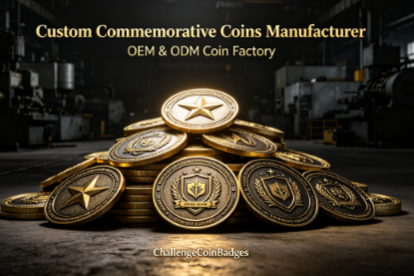
Commemorative coins are more than metal products. They can preserve a milestone, recognize service, celebrate an anniversary, commemorate an event, or strengthen an organization’s identity. When the coin is designed correctly, size, material, relief, finish, quantity and packaging work together to determine both the visual impact and the manufacturing economics.
ChallengeCoinBadges is a professional custom metal product manufacturer specializing in custom commemorative coins, challenge coins, memorial coins, recognition coins, military coins, medals, police badges, military badges, lapel pins, cufflinks, keyrings and car emblems.
With 20+ years of custom metal manufacturing experience and a 100+ person manufacturing team, ChallengeCoinBadges provides OEM and ODM manufacturing solutions for organizations, companies, military groups, law-enforcement agencies, schools, sports teams, clubs, associations, distributors and event organizers.
Email: sales@challengecoinbadges.com
Website: www.challengecoinbadges.com
1. What Is a Commemorative Coin?
A commemorative coin is a custom metal product created to represent a specific:
- Event
- Person
- Organization
- Achievement
- Anniversary
- Service record
- Historical milestone
- Memorial
- Championship
- Graduation
- Recognition program
A commemorative coin can combine:
Logo + Portrait + Text + Date + Symbol + Relief + Color + Metal Finish
Unlike an ordinary promotional item, the design normally has a specific story.
For example:
Front
25th Anniversary
Company Logo
Reverse
2001–2026
“25 Years of Excellence”
The physical coin becomes a permanent representation of the milestone.
2. ChallengeCoinBadges as a Custom Coin Manufacturer
ChallengeCoinBadges is positioned as a custom metal manufacturing partner, rather than simply a reseller of standard coins.
Its main product categories include:
Custom Coins
- Commemorative coins
- Challenge coins
- Memorial coins
- Recognition coins
- Military coins
- Veteran coins
- Anniversary coins
- Corporate coins
- Event coins
- School coins
- Sports coins
Other Custom Metal Products
- Medals
- Police badges
- Military badges
- Metal badges
- Lapel pins
- Cufflinks
- Keyrings
- Car emblems
This multi-category capability allows organizations to create a coordinated recognition collection using similar artwork and finishing.
3. 20+ Years of Manufacturing Experience
ChallengeCoinBadges has more than 20 years of custom metal manufacturing experience and a 100+ person team.
A custom commemorative coin normally passes through multiple stages:
Concept → Artwork → Engineering → Tooling → Metal Production → Surface Treatment → Plating → Enamel → Inspection → Packaging
This is important because the final price and quality are not determined by metal alone.
For example:
- Increasing diameter increases surface area.
- Increasing thickness increases material consumption.
- 3D relief increases engineering complexity.
- Additional colors increase finishing work.
- Special edges require additional processing.
- Premium packaging increases presentation cost.
- Higher quantities can spread fixed setup costs.
Therefore, the best comparison is total specification versus total cost, rather than price per piece alone.
4. Data Analysis: What Determines the Price?
A useful simplified model is:
Total Project Cost = Fixed Setup/Tooling + Production + Finishing + Packaging + Logistics
And:
Unit Cost = Total Project Cost ÷ Quantity
Industry pricing guides identify quantity, size, thickness, color count, plating and additional features as major variables affecting custom coin pricing. (The Coin Locker)
This explains why two companies can quote very different prices for apparently similar coins.
One quote may be for:
- 40 mm
- 2D
- One plating
- No enamel
- Basic packaging
while another may be:
- 60 mm
- 3D
- Double-sided
- Multiple enamel colors
- Antique + bright dual plating
- Custom edge
- Presentation box
They are not equivalent products.
5. Size Comparison: 40 mm vs. 50 mm vs. 60 mm
For a round coin:
Face Area = π × r²
Let’s calculate the approximate face area.
| Diameter | Radius | Approx. Face Area |
|---|---|---|
| 40 mm | 20 mm | 1,257 mm² |
| 50 mm | 25 mm | 1,963 mm² |
| 60 mm | 30 mm | 2,827 mm² |
| 70 mm | 35 mm | 3,848 mm² |
This produces an important result:
50 mm vs. 40 mm
50 mm provides approximately 56% more face area.
60 mm vs. 40 mm
60 mm provides approximately 125% more face area.
70 mm vs. 40 mm
70 mm provides approximately 206% more face area.
A current custom coin specification page lists traditional brass-alloy sizes from 40 mm through 70 mm, with standard thickness around 3–3.5 mm. (Challenge Coin Company)
What does this mean?
If a design contains:
- Portrait
- Name
- Dates
- Organization logo
- Motto
- Multiple symbols
a larger coin can provide significantly more room for visual hierarchy.
6. But Bigger Does Not Always Mean Better
A 70 mm coin is not automatically superior to a 45 mm coin.
The key metric is:
Design Efficiency = Meaningful Information ÷ Available Design Area
A 45 mm coin with:
- One strong emblem
- Clear typography
- Balanced borders
- Appropriate relief
may look better than a 70 mm coin filled with excessive text.
Therefore:
Choose the size according to the artwork—not simply the largest available diameter.
7. Popular Commemorative Coin Sizes
A useful starting point is:
40–45 mm
Good for:
- School events
- Simple recognition
- Compact commemorative products
- Basic organization coins
45–50 mm
Good for:
- Military coins
- Police coins
- Corporate recognition
- Anniversary coins
- Memorial coins
50–60 mm
Good for:
- Detailed artwork
- Portraits
- VIP recognition
- Championship coins
- Collector products
60–70 mm+
Good for:
- Presentation coins
- Highly detailed artwork
- Large 3D relief
- Limited editions
These are design starting points, not mandatory specifications.
8. Material Comparison: Brass vs. Zinc Alloy
Modern custom challenge and commemorative coins are commonly produced using brass or zinc alloy as base metals. A recent industry guide describes these two materials as the dominant choices for custom challenge coins. (KidderCorp)
Brass
Brass is commonly selected for:
- Traditional coin appearance
- Solid hand feel
- Die-struck designs
- Classic recognition products
- Premium commemorative applications
Zinc Alloy
Zinc alloy is particularly useful for:
- Complex shapes
- 3D relief
- Deep sculpting
- Cut-out designs
- Intricate artwork
One manufacturer specifically lists zinc alloy for custom shapes and sizes, while brass alloy is used for traditional round coin sizes. (Challenge Coin Company)
Simple Comparison
| Feature | Brass | Zinc Alloy |
|---|---|---|
| Traditional coin feel | Excellent | Good |
| Complex shapes | Good | Excellent |
| 3D relief | Excellent | Excellent |
| Custom cut-outs | Moderate | Excellent |
| Classic appearance | Excellent | Excellent |
| Complex sculpting | Good | Excellent |
The final material should be selected after reviewing the actual design.
9. 2D vs. 3D Commemorative Coins
This is another major production decision.
2D
Best for:
- Logos
- Text
- Dates
- Flags
- Simple insignia
- Graphic artwork
3D
Best for:
- Portraits
- People
- Aircraft
- Vehicles
- Buildings
- Animals
- Statues
- Detailed mascots
- Sculptural symbols
A current custom coin manufacturer describes 3D sculpting as suitable for subjects such as people, vehicles, aircraft, mountains, trees and insignia. (Challenge Coin Company)
Another manufacturer lists standard die-cast thickness at 2 mm minimum, 3 mm+ as standard, and 4 mm+ for 3D relief. (徽章工艺品)
Conclusion
If the design is primarily graphic:
2D may be sufficient.
If the design depends on physical depth:
3D may provide substantially greater visual impact.
10. 2D vs. 3D Cost Logic
3D does not simply mean “more expensive.”
The actual cost depends on:
- Size
- Thickness
- Relief depth
- Number of sides
- Material
- Tooling
- Finish
- Quantity
However, 3D generally requires more engineering and tooling than a simple 2D design.
Therefore:
3D should be used where it creates meaningful visual value.
For example:
Good 3D Application
A firefighter portrait.
Less Necessary 3D Application
A simple company logo consisting of text and a basic geometric symbol.
11. Plating Comparison
The metal base is only one part of the appearance.
Common plating options include:
- Gold
- Silver
- Copper
- Bronze
- Black nickel
- Antique gold
- Antique silver
- Antique copper
- Dual plating
These options are currently offered across the custom coin industry. (Challenge Coin Company)
Bright Gold
Creates a:
Premium + celebratory + luxury
appearance.
Bright Silver
Creates a:
Modern + clean + professional
appearance.
Antique Gold
Creates a:
Traditional + historical + military
appearance.
Antique Silver
Creates a:
Classic + restrained + recognition
appearance.
12. Why Antique Finishes Are Popular
Antique plating can create contrast between:
Raised Metal
and
Recessed Background
This is particularly useful for:
- 3D coins
- Military coins
- Memorial coins
- Historical coins
- Badge-style designs
The recessed areas become darker while raised areas remain visually prominent.
This can make sculpted details easier to see without relying entirely on enamel.
13. Enamel Comparison
Custom commemorative coins can use:
Soft Enamel
Characteristics:
- Recessed color
- Raised metal borders
- Textured surface
- Strong color contrast
Hard Enamel
Characteristics:
- Smooth surface
- Polished appearance
- More jewelry-like finish
Current custom coin specifications distinguish soft enamel from hard enamel, with hard enamel producing a flat, smooth finish. (Challenge Coin Company)
Comparison
| Feature | Soft Enamel | Hard Enamel |
|---|---|---|
| Surface | Textured/recessed | Smooth |
| Metal borders | Clearly visible | Less visually pronounced |
| Appearance | Bold | Premium |
| Suitable for | Logos, teams, events | Awards, premium recognition |
14. Data Analysis: Quantity and Fixed Costs
One of the most important economic principles in custom coin manufacturing is fixed-cost allocation.
Suppose a hypothetical project has:
$500 tooling/setup cost
100 coins
$500 ÷ 100 = $5 setup allocation per coin
500 coins
$500 ÷ 500 = $1 per coin
1,000 coins
$500 ÷ 1,000 = $0.50 per coin
5,000 coins
$500 ÷ 5,000 = $0.10 per coin
These are illustrative calculations, not ChallengeCoinBadges pricing.
The calculation demonstrates why unit prices generally become more attractive as production quantity increases.
A recent 2026 pricing guide similarly explains that tooling/setup costs are largely fixed and therefore spread across the production run. (The Coin Locker)
15. Real-World Pricing Comparison
Publicly available 2026 pricing tables show a clear quantity effect.
For example, one supplier lists a 1.5-inch die-struck coin at:
- $5.82 each for 50
- $3.57 each for 100
- $3.02 each for 300
- $2.88 each for 1,000
- $2.83 each for 2,000
for its stated configuration. (挑战币百科)
Another published price table lists a 1.5-inch die-struck coin at $5.19 for 100 pieces and $3.65 for 5,000 pieces. (Adinaline)
These are competitor/public reference prices, not ChallengeCoinBadges quotations.
The data demonstrates the basic economic relationship:
Quantity ↑ → Fixed Cost per Coin ↓ → Unit Price Often ↓
But this should not be used to compare manufacturers without matching specifications.
16. Why Comparing Only “Price Per Coin” Is Dangerous
Imagine two quotes:
Supplier A
$2.80/coin
- 40 mm
- 2D
- One side
- Basic plating
- No packaging
Supplier B
$4.20/coin
- 50 mm
- Double-sided
- 3D
- Enamel
- Antique finish
- Custom edge
- Individual packaging
Supplier B is not necessarily more expensive in value terms.
The specifications are completely different.
A better purchasing formula is:
Comparable Cost = Price ÷ Comparable Specification
Always compare:
- Same diameter
- Same thickness
- Same material
- Same number of sides
- Same relief
- Same enamel
- Same plating
- Same edge
- Same packaging
- Same quantity
17. Diameter vs. Unit Cost
Public pricing tables also show that larger diameters generally increase listed unit prices within the same production method and quantity. For example, one published die-struck table lists higher prices as size increases from 1.5 inches to 3 inches at the same quantity tier. (挑战币百科)
This makes manufacturing sense because larger coins generally require:
- More material
- Larger tooling area
- More surface finishing
- More packaging space
- Greater shipping weight
Therefore:
Size ↑ → Manufacturing Inputs ↑
But the larger size may also deliver:
Design Area ↑ → Readability ↑ → Visual Impact ↑
The buyer has to balance these two effects.
18. Information Density Analysis
Consider a 40 mm coin containing:
- Portrait
- Name
- Rank
- Badge
- Organization
- Dates
- Quote
- Motto
This can become visually crowded.
A better solution may be:
Front
Portrait + Name
Reverse
Badge + Dates + Organization
The information has been distributed across two sides.
This gives:
Lower Information Density + Higher Readability
without necessarily increasing the number of coins produced.
19. Front vs. Reverse Design Strategy
A good commemorative coin often uses the two sides differently.
Front = Identity
Use:
- Portrait
- Logo
- Mascot
- Main symbol
- Anniversary number
Reverse = Information
Use:
- Date
- Motto
- Recognition text
- Organization
- Event name
- Historical information
This approach creates a natural reading hierarchy.
20. Custom Edge Analysis
The edge is an opportunity to differentiate a coin.
Common options include:
- Plain edge
- Rope edge
- Reeded edge
- Wave edge
- Diamond-cut edge
- Petal-cut edge
- Custom pattern
These options are offered by established custom coin manufacturers. (Challenge Coin Company)
Standard Edge
Best for:
Cost efficiency + clean appearance
Rope Edge
Best for:
Traditional + military + commemorative designs
Custom Edge
Best for:
Premium + collector + special-event designs
21. Engraving and Numbering
Laser engraving can add:
- Names
- Dates
- Serial numbers
- Edition numbers
- Personal messages
Sequential numbering is particularly useful for limited editions.
For example:
001/500
002/500
003/500
A current custom coin manufacturer lists sequential numbering and side-wall engraving among available options. (Challenge Coin Company)
22. Commemorative Coins vs. Challenge Coins
There is substantial overlap between these products.
Commemorative Coin
Primary purpose:
Remember an event or milestone
Challenge Coin
Primary purpose:
Recognition, identity, membership or achievement
Hybrid Product
A coin can serve both functions.
For example:
Military Unit Anniversary Challenge Coin
can simultaneously:
- Commemorate the anniversary
- Recognize unit members
- Preserve organizational history
This hybrid approach is one reason custom coins work across many industries.
23. Commemorative Coins vs. Medals
| Category | Coin | Medal |
|---|---|---|
| Pocket carrying | Excellent | Limited |
| Two-sided design | Excellent | Excellent |
| Collectibility | High | High |
| Military recognition | Excellent | Excellent |
| Event awards | Good | Excellent |
| Display | Good | Excellent |
| Presentation | Good | Excellent |
| Compact keepsake | Excellent | Moderate |
If the product needs to be carried and collected:
Coin
may be more practical.
If the product is primarily an award:
Medal
may be more appropriate.
24. Brass vs. Zinc Alloy: Application Comparison
Choose Brass When:
- Traditional coin appearance is important.
- A solid metal feel is desired.
- The design is relatively conventional.
- The customer prefers a classic die-struck style.
Choose Zinc Alloy When:
- The shape is complex.
- Deep 3D relief is important.
- Cut-outs are required.
- The design contains sculptural details.
Industry sources also identify brass and zinc alloy as primary materials for custom challenge coins. (KidderCorp)
25. Study Case 1: Corporate 25th Anniversary
Customer Objective
A company wants to celebrate its 25th anniversary in 2026.
Front
25 YEARS
Company Logo
Reverse
2001–2026
“25 Years of Excellence”
Suggested Specification
- 45–50 mm
- Double-sided
- Brass or zinc alloy
- 2D + selective 3D
- Gold or silver plating
- Optional enamel
- Presentation packaging
Data Reasoning
The 25 is the most important element.
The logo is second.
The dates are supporting information.
This hierarchy prevents the coin from becoming overcrowded.
26. Study Case 2: Veteran Recognition Coin
Customer Objective
A military organization wants to honor a veteran.
Front
3D portrait
Name
Rank
Reverse
Unit insignia
Service years
Motto
Suggested Specification
- 45–55 mm
- Double-sided
- 3D portrait
- Antique silver or gold
- Selective enamel
- Rope edge
Why?
The portrait requires physical depth.
The antique finish increases contrast.
The rope edge reinforces the traditional commemorative appearance.
27. Study Case 3: Police Recognition Coin
Front
Police badge
Department name
Reverse
Officer name
Recognition award
Year
Suggested Specification
- 45–50 mm
- Brass or zinc alloy
- 2D/3D hybrid
- Antique silver
- Optional blue enamel
Data Reasoning
The badge can remain primarily 2D while the central emblem receives selective 3D relief.
This avoids unnecessary complexity.
28. Study Case 4: Firefighter Memorial Coin
Front
3D firefighter helmet
Department emblem
Reverse
Name
Service dates
Memorial message
Recommended Direction
- 50–60 mm
- Zinc alloy
- 3D relief
- Antique gold/silver
- Selective enamel
- Presentation box
A larger diameter is justified because the helmet, emblem and text require sufficient visual space.
29. Study Case 5: School Graduation Coin
Front
University logo
Mascot
Reverse
CLASS OF 2026
School name
Suggested Specification
- 40–45 mm
- Brass
- 2D
- Soft enamel
- Bright gold or silver
Why?
The design is relatively graphic.
A complicated 3D mold may not provide enough additional value to justify the extra complexity.
30. Study Case 6: Sports Championship Coin
Front
3D trophy
Team mascot
Reverse
Championship name
Year
Suggested Specification
- 50–60 mm
- Zinc alloy
- 3D relief
- Team-color enamel
- Gold plating
- Custom edge
The trophy and mascot create the visual focus.
Enamel reinforces team identity.
31. Study Case 7: Limited-Edition Collector Coin
Specification
- 60 mm
- 3D
- Double-sided
- Dual plating
- Custom edge
- Sequential numbering
- Presentation box
Numbering
001/500
Data Reasoning
This type of product prioritizes:
Exclusivity + Detail + Presentation
rather than minimizing unit cost.
32. Manufacturing Process at a Glance
A professional custom commemorative coin project can be divided into:
Phase 1 — Design
Customer supplies:
- Logo
- Photo
- Sketch
- Artwork
- Text
Phase 2 — Engineering
Manufacturer confirms:
- Size
- Thickness
- Material
- Relief
- Edge
- Plating
- Color
Phase 3 — Tooling
Production tooling is developed according to the approved artwork.
Phase 4 — Metal Manufacturing
Coins are formed through the selected manufacturing process.
Phase 5 — Surface Treatment
Possible treatments include:
- Polishing
- Sandblasting
- Plating
- Antique finishing
Phase 6 — Enamel
Colors are added when required.
Phase 7 — Inspection
Products are checked against specifications.
Phase 8 — Packaging
Coins are packed for shipment or presentation.
33. Quality Control Analysis
For commemorative products, quality control is especially important because they often contain names, dates, portraits and historical information.
Important inspection points include:
Artwork
Does the finished coin match the approved artwork?
Text
Are names and dates correct?
Dimensions
Is diameter within specification?
Thickness
Is the profile consistent?
Relief
Are the important details visible?
Plating
Is the finish uniform?
Enamel
Are colors correctly filled?
Edge
Are edges clean and free from defects?
Packaging
Does the packaging protect the finished coin?
34. Why Proof Approval Is Important
Before bulk manufacturing, customers should verify:
- Spelling
- Names
- Dates
- Numbers
- Logos
- Portraits
- Colors
- Front/reverse orientation
- Size
- Thickness
- Finish
For a memorial coin, a single incorrect date can be more serious than a minor cosmetic defect.
Therefore:
Artwork approval should be treated as a critical production checkpoint.
35. Packaging Comparison
Polybag
Best for:
- Large-volume distribution
- Events
- Cost-sensitive orders
Coin Capsule
Best for:
- Collectors
- Protection
- Retail-style presentation
Velvet Pouch
Best for:
- Recognition
- Gifts
- Military presentation
Wooden Box
Best for:
- VIP recognition
- Memorial products
- Limited editions
- Corporate awards
Packaging should match the product’s purpose.
36. How to Calculate the Best Quantity
Suppose an organization needs 850 coins.
Possible purchasing strategies:
Option A
Order exactly 850.
Option B
Order 1,000.
The correct decision depends on:
Additional 150 Coins Cost vs. Future Demand
If the incremental cost of moving to 1,000 units is relatively small, having additional inventory may make sense.
Public pricing tables demonstrate that larger production tiers can materially reduce per-unit cost. (Custom Challenge Coins)
But buyers should always request an actual quotation based on their own specifications.
37. A Better Way to Compare Factory Quotations
When comparing ChallengeCoinBadges with another manufacturer, use this checklist:
| Specification | Supplier A | Supplier B |
|---|---|---|
| Quantity | ||
| Diameter | ||
| Thickness | ||
| Material | ||
| Sides | ||
| 2D/3D | ||
| Enamel | ||
| Plating | ||
| Edge | ||
| Engraving | ||
| Packaging | ||
| Shipping | ||
| Tooling | ||
| Sample | ||
| Lead time |
This creates a genuine apples-to-apples comparison.
38. Why Factory Capability Matters
The manufacturer’s capability can influence:
- Engineering accuracy
- 3D detail
- Surface quality
- Color consistency
- Plating quality
- Production stability
- Reorder consistency
ChallengeCoinBadges combines:
20+ Years Experience + 100+ People + OEM/ODM Manufacturing
This allows the brand to support both individual custom projects and larger B2B programs.
39. OEM Manufacturing
For OEM projects, the customer may already have:
- Complete artwork
- Brand guidelines
- Exact dimensions
- Packaging requirements
- Technical specifications
ChallengeCoinBadges can manufacture according to the approved specification.
This is particularly useful for:
- Promotional distributors
- Military suppliers
- Corporate procurement
- Event companies
- Recognition-product wholesalers
40. ODM Manufacturing
For ODM projects, customers may only have:
- Logo
- Theme
- Event
- Target audience
- Basic concept
The manufacturer can help convert that concept into:
Production-Ready Artwork + Metal Specification
This is useful when the customer knows what the coin should represent but does not have professional metal-product engineering experience.
41. Data-Driven Design Formula
A useful framework for planning a commemorative coin is:
Step 1
Define the purpose.
Step 2
Define the recipient.
Step 3
Identify the most important visual element.
Step 4
Select the diameter based on information density.
Step 5
Select 2D or 3D based on artwork.
Step 6
Select the material.
Step 7
Select plating and enamel.
Step 8
Select the edge.
Step 9
Determine quantity.
Step 10
Determine packaging.
This prevents buyers from selecting specifications randomly.
42. Recommended Specifications by Application
| Application | Diameter | Relief | Material | Finish |
|---|---|---|---|---|
| Simple Event | 40–45 mm | 2D | Brass | Bright |
| Corporate Anniversary | 45–50 mm | 2D/3D | Brass/Zinc | Gold/Silver |
| Military | 45–55 mm | 2D/3D | Brass/Zinc | Antique |
| Memorial | 45–60 mm | 3D | Zinc/Brass | Antique |
| Police | 45–50 mm | 2D/3D | Brass/Zinc | Silver |
| Firefighter | 50–60 mm | 3D | Zinc | Antique |
| Graduation | 40–45 mm | 2D | Brass | Enamel |
| Championship | 50–60 mm | 3D | Zinc | Gold + Enamel |
| VIP | 50–60 mm | 3D | Brass/Zinc | Premium |
| Collector | 55–70 mm | 3D | Brass/Zinc | Dual Plating |
These are design recommendations, not fixed ChallengeCoinBadges specifications.
43. The Three Most Important Comparisons
If you have limited time when evaluating a coin project, compare these three areas first:
1. Size
40 mm vs. 50 mm vs. 60 mm
Determine whether the artwork fits comfortably.
2. Relief
2D vs. 3D
Determine whether physical depth adds meaningful value.
3. Quantity
100 vs. 500 vs. 1,000+
Determine how fixed setup costs affect the economics.
These three variables often have a major influence on the final product.
44. ChallengeCoinBadges Product Strategy
ChallengeCoinBadges can help customers develop a complete metal recognition program:
Event
Commemorative Coin
Winner
Medal
Organization
Lapel Pin
Officer
Badge
Executive
Cufflinks
Souvenir
Keyring
This creates a consistent visual identity across multiple products.
45. Why Custom Metal Coins Remain Valuable
A digital image can be copied instantly.
A physical metal coin is different.
It can be:
- Held
- Carried
- Displayed
- Collected
- Presented
- Archived
- Passed to future generations
That physical durability is the fundamental value of commemorative metal products.
46. Final Conclusion
Commemorative Coins Manufacturer | Custom Metal Coins & Challenge Coins is not simply a manufacturing category. It represents a combination of design engineering, metal processing, recognition strategy and long-term keepsake value.
The data provides several important conclusions:
- A 50 mm coin has approximately 56% more face area than a 40 mm coin.
- A 60 mm coin has approximately 125% more face area than a 40 mm coin.
- Common custom coin specifications include approximately 40–70 mm diameters and around 3–3.5 mm standard thickness in one established manufacturer’s specification. (Challenge Coin Company)
- Brass and zinc alloy are among the principal base metals used for custom challenge coins. (KidderCorp)
- 3D relief can require thicker profiles and more complex engineering than basic 2D designs. (徽章工艺品)
- Public 2026 pricing tables demonstrate that higher quantities can substantially reduce unit pricing, because fixed setup/tooling costs are distributed across more pieces. (挑战币百科)
- Larger coins generally cost more, but they also provide substantially more design area.
- A higher price does not automatically mean better value—the specifications must be matched before comparing quotations.
For buyers, the ideal formula is:
Purpose + Design + Size + Material + Relief + Finish + Quantity + Packaging = Right Commemorative Coin
ChallengeCoinBadges provides custom manufacturing for:
Custom Commemorative Coins | Custom Metal Coins | Challenge Coins | Memorial Coins | Recognition Coins | Military Coins | Medals | Police Badges | Military Badges | Lapel Pins | Cufflinks | Keyrings
With 20+ years of manufacturing experience and a 100+ person team, ChallengeCoinBadges provides OEM and ODM manufacturing support for organizations and businesses seeking customized metal recognition products.
ChallengeCoinBadges
Email: sales@challengecoinbadges.com
Website: www.challengecoinbadges.com
Keywords
commemorative coins manufacturer, custom commemorative coins manufacturer, commemorative coin factory, custom metal coins manufacturer, custom metal coin factory, custom challenge coins manufacturer, challenge coin manufacturer, challenge coin factory, personalized commemorative coins, custom commemorative metal coins, custom recognition coins, recognition coin manufacturer, memorial coins manufacturer, custom memorial coins, personalized memorial coins, custom challenge coins, personalized challenge coins, military challenge coins, military commemorative coins, military coins manufacturer, veteran challenge coins, veteran commemorative coins, police challenge coins, police commemorative coins, firefighter challenge coins, firefighter commemorative coins, first responder coins, corporate commemorative coins, corporate challenge coins, company anniversary coins, anniversary commemorative coins, employee recognition coins, retirement recognition coins, school commemorative coins, graduation challenge coins, university commemorative coins, sports commemorative coins, championship challenge coins, event commemorative coins, organization challenge coins, club challenge coins, association commemorative coins, nonprofit recognition coins, historical commemorative coins, special occasion coins, custom memorial coins manufacturer, 3D commemorative coins, 3D challenge coins, 2D commemorative coins, 2D challenge coins, double sided commemorative coins, double sided challenge coins, brass commemorative coins, brass challenge coins, zinc alloy commemorative coins, zinc alloy challenge coins, antique commemorative coins, antique challenge coins, gold plated commemorative coins, silver plated commemorative coins, soft enamel challenge coins, hard enamel challenge coins, engraved commemorative coins, numbered commemorative coins, custom edge challenge coins, custom shaped commemorative coins, limited edition commemorative coins, OEM commemorative coins, ODM commemorative coins, wholesale commemorative coins, bulk commemorative coins, custom coin supplier, custom coin manufacturer China, commemorative coin manufacturer China, challenge coin factory China, custom metal product manufacturer, custom medal manufacturer, custom police badge manufacturer, custom military badge manufacturer, custom lapel pin manufacturer, custom cufflink manufacturer, custom keyring manufacturer, ChallengeCoinBadges, ChallengeCoinBadges manufacturer, ChallengeCoinBadges factory, ChallengeCoinBadges commemorative coins, ChallengeCoinBadges challenge coins, ChallengeCoinBadges memorial coins, ChallengeCoinBadges recognition coins, ChallengeCoinBadges military coins.