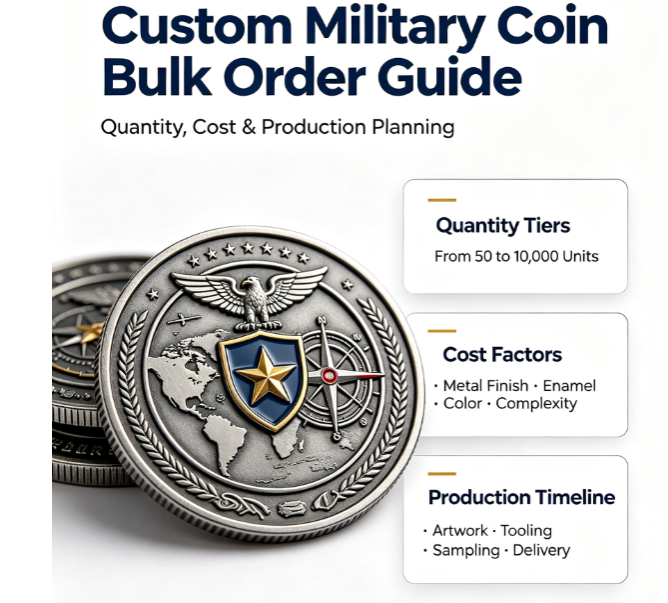
Ordering custom military coins in bulk is very different from buying a small number of ready-made coins.
A bulk order requires careful planning around quantity, unit cost, tooling, materials, size, thickness, finishes, packaging, production capacity, quality control and shipping.
Whether you are ordering 100, 500, 1,000, 5,000, 10,000 or 50,000 custom military coins, the objective is not simply to obtain the lowest unit price. The goal is to find the right balance between quantity, quality, total landed cost and delivery schedule.
This guide explains how to plan a bulk military coin order from the first artwork file through final delivery.
Quick Bulk Order Reference
| Quantity | Typical Use | Planning Consideration |
|---|---|---|
| 50–100 | Small ceremony / test order | Higher unit cost |
| 100–500 | Small organization | Flexible designs |
| 500–1,000 | Unit/event order | Good balance |
| 1,000–5,000 | Large events / organizations | Better economies of scale |
| 5,000–10,000 | Major programs | Production planning important |
| 10,000–50,000+ | Large campaigns / institutional orders | Capacity and logistics become critical |
These quantities are planning examples rather than fixed industry rules. Actual MOQ and pricing depend on the manufacturer and product specifications.
1. What Is a Bulk Military Coin Order?
A bulk order generally means producing a large quantity of identical or substantially similar custom coins in one production run.
Typical applications include:
- Military unit recognition
- Deployment commemorations
- Retirement ceremonies
- Command coins
- Training graduations
- Anniversaries
- Veterans’ organizations
- Recruiting events
- Government recognition
- Corporate recognition
- Collectible editions
The more pieces ordered, the more important production planning becomes.
2. Why Quantity Matters
Quantity affects the economics of custom manufacturing because several costs are fixed or semi-fixed.
For example:
Tooling cost
may be approximately the same whether you order:
100 coins or 10,000 coins.
Therefore, the tooling cost per piece becomes much smaller as quantity increases.
Simplified example
Suppose tooling costs:
$100
At 100 pieces:
$100 ÷ 100 = $1.00 per coin
At 1,000 pieces:
$100 ÷ 1,000 = $0.10 per coin
At 10,000 pieces:
$100 ÷ 10,000 = $0.01 per coin
This illustrates why bulk orders can achieve lower effective tooling cost per piece.
3. Typical Bulk Quantity Levels
A practical planning structure is:
50–100 Pieces
Suitable for:
- Small ceremonies
- Leadership gifts
- Design testing
- Limited editions
100–500 Pieces
Suitable for:
- Small units
- Corporate programs
- Local organizations
500–1,000 Pieces
Suitable for:
- Unit-wide recognition
- Events
- Graduations
- Anniversaries
1,000–5,000 Pieces
Suitable for:
- Large events
- Large organizations
- Multi-event programs
5,000+ Pieces
Suitable for:
- Large campaigns
- National organizations
- Large recognition programs
- Major promotional programs
4. Does Buying More Always Mean a Lower Price?
Usually, the unit cost tends to decrease as quantity increases, but not indefinitely.
Why?
Because the manufacturer still needs to pay for:
- Metal
- Tooling
- Labor
- Finishing
- Enamel
- Packaging
- QC
- Shipping
Material consumption increases directly with quantity.
Therefore, a 10,000-piece order will not normally cost only a tiny fraction of a 1,000-piece order.
The important metric is:
Cost per piece
rather than total order value alone.
5. Example Bulk Pricing Structure
Consider a hypothetical standard military coin.
| Quantity | Example Unit Price* | Product Cost |
|---|---|---|
| 100 | $3.20 | $320 |
| 500 | $2.20 | $1,100 |
| 1,000 | $1.85 | $1,850 |
| 5,000 | $1.40 | $7,000 |
| 10,000 | $1.20 | $12,000 |
*These figures are illustrative examples, not current quotations. Actual prices depend on size, thickness, material, design complexity, finish, enamel, packaging and shipping.
The important observation is that the unit price can decline significantly as fixed costs are spread across more pieces.
6. What Determines Military Coin Cost?
The main variables include:
1. Quantity
Higher quantity can reduce unit cost.
2. Size
Larger coins generally require more material.
3. Thickness
Thicker coins generally use more metal.
4. Material
Brass, copper and zinc alloy have different manufacturing characteristics and costs.
5. Design
3D and complex designs require more engineering.
6. Finish
Plating and surface treatments affect cost.
7. Enamel
Additional enamel colors can increase processing requirements.
8. Edge
Special edges can require additional tooling.
9. Packaging
Custom boxes and bags add cost.
10. Shipping
Weight and volume affect transportation costs.
7. Size Has a Major Impact
Common military coin sizes include:
- 1.25 inch
- 1.5 inch
- 1.75 inch
- 2 inch
- 2.25 inch
- Larger custom sizes
A larger coin generally requires more:
- Metal
- Polishing
- Plating
- Packaging space
- Shipping weight
Therefore, size should be finalized before comparing quotations.
8. Why 1.75 Inches Is Popular
A 1.75-inch military coin provides a useful balance between:
- Design space
- Weight
- Cost
- Portability
It can accommodate:
- Unit emblems
- 3D relief
- Multiple colors
- Edge lettering
without becoming excessively large.
9. Thickness and Cost
Common custom coin thicknesses may include:
2 mm
3 mm
4 mm
Thicker coins generally have:
- Greater weight
- More material
- A heavier feel
But they can also increase manufacturing and shipping costs.
10. Material Selection
Common materials include:
Brass
Good for many detailed custom coins.
Copper
Often selected for premium die-struck products.
Zinc Alloy
Useful for complex 3D shapes.
Iron
Can be used for certain economical designs.
Material should be selected according to:
Design + application + appearance + budget
rather than price alone.
11. 2D vs 3D Bulk Orders
2D Coin
Generally simpler.
3D Coin
May require more complex tooling and engineering.
For 5,000 or 10,000 pieces, a complicated 3D design should be reviewed carefully before production.
12. Double-Sided Military Coins
Double-sided coins contain artwork on both faces.
They may include:
Front: Unit emblem
Back: Mission / aircraft / symbol
Edge: Date or motto
Compared with a simple one-sided design, double-sided manufacturing can require additional tooling and finishing considerations.
13. Edge Lettering
Bulk military coins frequently use edge lettering for:
- Unit
- Motto
- Date
- Operation
- Location
- Serial number
- Anniversary
For large orders, proofread all edge text before mold production.
A single spelling error can potentially affect the entire batch.
14. Enamel Options
Military coins can use:
Soft Enamel
Provides recessed color areas.
Hard Enamel
Provides a flatter, polished appearance.
No Enamel
Relies on metal relief and plating.
The choice affects:
- Appearance
- Manufacturing complexity
- Inspection
- Cost
15. Number of Enamel Colors
A coin with one enamel color may be simpler than one with:
- 3 colors
- 5 colors
- 8 colors
More colors can require more filling and inspection.
For large orders, color consistency becomes especially important.
16. Plating Options
Common finishes include:
- Bright gold
- Bright silver
- Antique gold
- Antique silver
- Antique brass
- Black nickel
- Copper
- Satin finishes
The finish should be included in the RFQ.
Simply asking for:
“Gold coin”
is not specific enough.
17. Bright vs Antique Finish
Bright Gold
Clean and premium appearance.
Antique Gold
Older, traditional appearance with stronger relief contrast.
Bright Silver
Modern appearance.
Antique Silver
Strong contrast between recessed and raised areas.
The appropriate finish depends on the design and intended use.
18. Custom Military Coin Tooling
Tooling is usually a one-time or project-specific cost.
The tooling process may include:
Artwork → Engineering → CNC/engraving → Mold preparation → Testing
Complex 3D coins may require more engineering than simple 2D coins.
19. Why Bulk Orders Need Better Tooling Control
If you order:
5,000 coins
the mold becomes extremely important.
A tooling problem can affect thousands of pieces.
Therefore, large orders should ideally have:
- Approved artwork
- Approved digital proof
- Clear specifications
- Sample approval when appropriate
- Documented production requirements
20. Lead Time for Bulk Military Coins
A standard custom military coin project may require approximately:
15–25 production days
after final artwork approval.
Complex projects can require:
20–35+ days
depending on:
- 3D relief
- Multiple finishes
- Multiple components
- Quantity
- Packaging
- Production capacity
Shipping is separate.
21. Example 1,000-Piece Production Schedule
A hypothetical schedule:
| Stage | Days |
|---|---|
| Artwork | 1–3 |
| Tooling | 3–7 |
| Metal production | 3–5 |
| Finishing | 2–4 |
| Enamel | 1–3 |
| QC | 1–2 |
| Packaging | 1–2 |
Possible total:
15–25 production days
22. Example 10,000-Piece Production Schedule
A large order may require:
Artwork approval: 2–3 days
Tooling: 5–7 days
Metal production: 5–10 days
Finishing: 3–5 days
Enamel: 2–4 days
QC: 2–3 days
Packaging: 2–3 days
Potential planning range:
20–35 days
Actual timing depends on factory capacity.
23. Production Capacity Matters More at 10,000+ Pieces
A supplier capable of producing:
500 pieces/week
may struggle with:
20,000 pieces
A factory with larger production capacity may provide more predictable scheduling.
Ask:
“What is your normal monthly production capacity for this product?”
24. Bulk Order and Factory Capacity
Capacity includes:
- Tooling capacity
- Metal forming capacity
- Polishing capacity
- Plating capacity
- Enamel capacity
- Assembly capacity
- Packaging capacity
A bottleneck in any one stage can delay the entire order.
25. Quality Control for Bulk Orders
Large orders require systematic inspection.
Important checks include:
- Size
- Thickness
- Weight
- Plating
- Enamel
- Relief
- Lettering
- Hardware
- Quantity
- Packaging
A single sample cannot always represent an entire production batch.
26. Random Sampling
For larger orders, manufacturers may inspect samples from the production batch.
The exact inspection method can vary.
For example:
10,000 coins
could involve inspecting a statistically determined sample rather than manually checking every single coin.
For critical products, buyers can discuss inspection standards with the manufacturer.
27. AQL and Military Coin Orders
AQL means:
Acceptable Quality Limit
It is a statistical sampling approach used in manufacturing inspection.
If your project requires formal inspection standards, specify them before production.
Do not assume that every factory automatically uses the same AQL level.
28. Weight Control
Weight can be useful as a secondary production check.
If the approved coin should weigh approximately:
30 g
and production pieces vary significantly, the buyer may want to investigate.
However, weight alone does not prove quality.
Dimensions, finish and construction should also be checked.
29. Bulk Packaging
For 1,000+ coins, packaging becomes important.
Possible options:
- Poly bags
- Velvet pouches
- Plastic cases
- Presentation boxes
- Custom gift boxes
- Individual cards
- Foam inserts
Packaging should be specified before production.
30. Carton Planning
Large orders require proper carton planning.
For example:
100 coins/carton
would mean:
1,000 coins = 10 cartons
This can simplify inventory counting.
Actual carton quantities depend on coin size, packaging and carton specifications.
31. Shipping Cost
Shipping cost depends on:
- Quantity
- Coin size
- Coin weight
- Packaging
- Carton dimensions
- Destination
- Shipping method
A 10,000-piece order can be significantly heavier than a 1,000-piece order.
32. Landed Cost
The buyer should consider:
Product Cost + Tooling + Packaging + Shipping + Import Charges
where applicable.
This is more useful than comparing factory unit prices alone.
33. Example Total Cost Analysis
Hypothetical 5,000-piece order:
| Cost | Example |
|---|---|
| Product | $7,000 |
| Tooling | $100 |
| Packaging | $500 |
| Shipping | $800 |
| Other costs | $100 |
| Total | $8,500 |
Effective landed cost:
$8,500 ÷ 5,000 = $1.70 per coin
Again, these figures are illustrative.
34. Why Shipping Can Change the Best Supplier
Supplier A:
$1.40/coin
Supplier B:
$1.50/coin
If Supplier A has much higher shipping costs, the final landed cost may be similar—or even higher.
Always compare:
Total delivered cost
35. Should You Order More to Lower Cost?
Not always.
Suppose you need:
1,000 coins
A supplier offers:
1,000 = $1.80
5,000 = $1.40
It may be tempting to order 5,000.
But if you only need 1,000, the additional 4,000 coins create:
- Inventory cost
- Storage requirements
- Cash tied up in inventory
- Potential design changes
- Obsolescence risk
The lowest unit price is not always the lowest business cost.
36. When a Larger Order Makes Sense
Increasing quantity may make sense when:
- The design will remain unchanged
- Future demand is predictable
- Storage is available
- The price difference is significant
- The product has a long usable life
37. When a Smaller Order Makes Sense
Smaller orders may be better when:
- Design is new
- Demand is uncertain
- The product is event-specific
- The organization may change
- You need to test the market
38. Bulk Order Study Case: 1,000 Coins
Hypothetical specifications:
- Quantity: 1,000
- Diameter: 1.75″
- Thickness: 3 mm
- Material: Brass
- Double-sided
- Two enamel colors
- Antique silver
- Individual velvet pouch
Assume:
Product cost: $1.85 × 1,000 = $1,850
Tooling:
$100
Packaging:
$200
Shipping:
$350
Estimated project cost:
$2,500
Effective delivered cost:
$2.50 per coin
This illustrates why the buyer should evaluate the entire project rather than unit price alone.
39. Bulk Order Study Case: 5,000 Coins
Hypothetical quotation:
$1.40 × 5,000 = $7,000
Tooling:
$100
Packaging:
$750
Shipping:
$900
Total:
$8,750
Effective cost:
$1.75 per delivered coin
The larger order significantly reduces the product unit cost, but logistics become more important.
40. Bulk Order Study Case: 10,000 Coins
Hypothetical:
$1.20 × 10,000 = $12,000
Tooling:
$100
Packaging:
$1,200
Shipping:
$1,500
Total:
$14,800
Effective delivered cost:
$1.48 per coin
The unit economics improve further, assuming demand justifies the larger inventory.
41. Quantity Breakpoint Analysis
Suppose a buyer is deciding between:
1,000 pieces
and
5,000 pieces
The question should not be:
“Which price is lower?”
The better question is:
“Will we realistically use the additional 4,000 pieces?”
This is an inventory decision as much as a manufacturing decision.
42. Inventory Risk
Excess inventory creates risk when:
- Unit design changes
- Organization changes
- Dates become outdated
- Leadership changes
- Event branding changes
- Regulations or specifications change
This is especially relevant to coins containing specific dates or personnel names.
43. Date-Specific Coins
A coin saying:
2026 ANNIVERSARY
has a limited period of relevance.
If you order 20,000 pieces but only distribute 3,000 per year, the remaining inventory may have limited future value.
Therefore, forecast demand carefully.
44. Personalized Coins
If every coin has a different:
- Name
- Number
- Rank
- Date
the manufacturing workflow becomes more complex.
Personalization can increase:
- Production time
- QC requirements
- Sorting
- Packaging complexity
45. Bulk Orders with Multiple Designs
Suppose you need:
- 2,000 Unit A
- 2,000 Unit B
- 1,000 Unit C
The total quantity is:
5,000
But three different designs may require:
- Three molds
- Three artwork approvals
- Three QC standards
Therefore, the unit price may differ from one 5,000-piece design.
46. One Mold vs Multiple Molds
One design:
5,000 pieces
may be more economical than:
Five designs × 1,000 pieces
even though the total quantity is identical.
Why?
Because each design may require separate tooling and setup.
47. Mixed Bulk Orders
A manufacturer may be able to combine production planning for:
- Challenge coins
- Medals
- Lapel pins
- Badges
But each product has its own manufacturing process.
The buyer should request separate pricing and lead times for each product.
48. Repeat Orders
Repeat orders can be more efficient because:
- Artwork is already approved
- Mold may already exist
- Specifications are documented
- Packaging may already be standardized
This can reduce setup requirements.
49. How to Plan Repeat Orders
Keep:
- Original artwork
- Production drawings
- Approved sample
- Material specification
- Plating specification
- Enamel colors
- Packaging specification
This creates a repeatable product standard.
50. Bulk Order Contract Details
Before production, confirm:
- Quantity
- Unit price
- Tooling
- Material
- Dimensions
- Thickness
- Finish
- Enamel
- Packaging
- Lead time
- Shipping
- Payment terms
- Defect handling
Written specifications reduce misunderstandings.
51. Payment Planning
Large orders may require deposits and balance payments.
For example, a manufacturer may structure payment around:
Deposit → Production → Balance → Shipment
Actual terms vary by supplier.
For large purchases, buyers should clearly understand when each payment is due.
52. Artwork Approval Before Deposit or Production
Ideally, the final specifications should be confirmed before mass production.
The buyer should receive:
- Final artwork
- Digital proof
- Dimensions
- Material
- Finish
- Quantity
and approve the production version.
53. Production Sample
For a large order, a physical sample can be especially valuable.
The sample allows the buyer to verify:
- Size
- Weight
- Relief
- Plating
- Enamel
- Edge
- Overall appearance
Once approved, it can serve as the production reference.
54. Bulk Order Quality Risks
Common problems include:
- Wrong dimensions
- Wrong plating
- Color inconsistency
- Poor enamel filling
- Blurred lettering
- Damaged edges
- Missing components
- Quantity shortage
- Packaging damage
These risks increase the importance of clear specifications.
55. How to Reduce Bulk Quality Risks
Use:
Approved artwork
Approved sample
Written specifications
Defined QC requirements
Final inspection
This provides a stronger quality-control framework.
56. Military Coin Weight Calculation
A rough relationship exists between:
Diameter + thickness + material density
and the final coin weight.
For a simplified solid-disc model:
Weight ≈ π × radius² × thickness × density
Real military coins are not perfect solid discs because:
- Relief changes volume
- Cut-outs reduce material
- Edge designs change geometry
- Casting shapes vary
Therefore, the formula is useful for estimating, not determining the final production weight.
57. Why Weight Matters in Bulk Orders
If the buyer expects a premium heavy coin, weight can be an important specification.
For example:
2 mm coin
vs.
4 mm coin
can produce a significant difference in perceived weight.
58. Cost per Gram Is Not Enough
Two coins with the same weight can have different costs because of:
- Tooling
- 3D complexity
- Plating
- Enamel
- Assembly
- Packaging
Therefore:
Weight ≠ total manufacturing cost
59. Bulk Order Production Efficiency
Manufacturers can often improve efficiency through batch production.
For example:
1,000 identical coins can be processed as a production batch.
This can reduce:
- Setup frequency
- Material changes
- Finishing changes
- Packaging complexity
However, efficiency depends on the factory.
60. Production Planning by Batch
A 10,000-piece order might be divided into production batches for:
- Metal forming
- Polishing
- Plating
- Enamel
- Assembly
- QC
Batch planning can make quality control easier.
61. Bottleneck Management
The slowest production stage can determine the overall schedule.
For example:
Metal production: 5 days
Plating: 3 days
Enamel: 10 days
The enamel stage becomes the potential bottleneck.
This is why buyers should ask for a complete production schedule.
62. Factory Communication for Large Orders
For 5,000+ pieces, regular communication can be useful.
Possible update points:
Stage 1
Artwork approved
Stage 2
Tool completed
Stage 3
Production underway
Stage 4
Finishing underway
Stage 5
QC completed
Stage 6
Packaging completed
Stage 7
Shipment dispatched
63. Production Photos
For larger orders, progress photos can help confirm:
- Tooling
- Semi-finished products
- Plating
- Enamel
- Packaging
Photos do not replace inspection, but they can improve project visibility.
64. Pre-Shipment Inspection
For large orders, the buyer can consider:
- Factory QC
- Third-party inspection
- Random sampling
- Quantity verification
- Packaging inspection
The appropriate inspection level depends on order value and risk.
65. Shipping Large Quantities
When shipping thousands of coins, ask for:
- Number of cartons
- Carton dimensions
- Gross weight
- Net weight
- Shipping method
- Tracking information
- Estimated transit time
This information helps with receiving and inventory planning.
66. Landed Cost Formula
A practical formula is:
Landed Cost = Product Cost + Tooling + Packaging + Freight + Applicable Import Costs
Then:
Landed Cost per Piece = Total Landed Cost ÷ Quantity
This is the number buyers should compare between suppliers.
67. Bulk Order Decision Formula
A useful business model is:
Total Cost = Unit Cost × Quantity + Fixed Costs + Logistics
Then consider:
Inventory Value + Demand Forecast + Delivery Risk
This provides a better decision framework than looking only at unit price.
68. When to Request Multiple Quotations
For large orders, obtain at least several comparable quotations when possible.
But make sure every supplier receives the same specification.
Otherwise:
Supplier A may quote:
2 mm zinc alloy
while Supplier B quotes:
3 mm brass
and the prices are not directly comparable.
69. Standardize Your RFQ
A professional RFQ should contain:
Product: Military challenge coin
Quantity: 5,000
Diameter: 1.75″
Thickness: 3 mm
Material: Brass
Sides: Double-sided
Finish: Antique silver
Enamel: 2 colors
Edge: Lettered
Packaging: Individual velvet pouch
Destination: USA
Required arrival: Specific date
This allows meaningful price comparison.
70. How to Negotiate Bulk Pricing
Instead of simply asking:
“Can you give me a lower price?”
ask:
“What is your best price for 1,000 / 3,000 / 5,000 / 10,000 pieces under the same specifications?”
This gives you a quantity-price curve.
71. Quantity Ladder Example
Ask for:
| Quantity | Price |
|---|---|
| 500 | Quote |
| 1,000 | Quote |
| 2,000 | Quote |
| 5,000 | Quote |
| 10,000 | Quote |
Then compare the incremental savings.
72. Incremental Cost Analysis
Suppose:
1,000 pieces = $1.80
5,000 pieces = $1.40
The additional 4,000 pieces cost:
$7,000 − $1,800 = $5,200
Therefore, the buyer is paying approximately:
$1.30 per additional piece
This can help determine whether increasing quantity makes financial sense.
73. Inventory Break-Even Analysis
If you expect future demand of:
4,000 additional coins
and ordering 5,000 now reduces the price substantially, bulk purchasing may make sense.
But if future demand is uncertain, holding inventory can be risky.
74. Bulk Order Planning for Events
For a fixed event:
Required quantity
Expected attendance
Extra inventory
should be calculated.
For example:
5,000 attendees
does not necessarily mean exactly:
5,000 coins
You may need a buffer for:
- VIPs
- Lost items
- Damaged products
- Additional attendees
75. How Much Extra Inventory Should You Order?
There is no universal percentage.
The appropriate buffer depends on:
- Event size
- Replacement difficulty
- Product value
- Delivery schedule
- Historical demand
For a critical event, discuss the appropriate quantity buffer with the manufacturer.
76. Bulk Order for Military Retirement
Retirement coins can have predictable distribution.
The buyer should calculate:
- Ceremony attendees
- Retiring member’s guests
- Command staff
- Unit members
- VIP recipients
- Extra keepsakes
This is different from ordering coins for general distribution.
77. Bulk Order for Military Anniversary
Anniversary coins may have:
- Historical date
- Unit designation
- Anniversary number
- Special packaging
Because the product is date-specific, demand forecasting is important.
78. Bulk Order for Graduation
Graduation coins often require:
- Class number
- Year
- Training school
- Unit
- Ceremony date
The delivery deadline is critical.
79. Bulk Order for Corporate Recognition
Corporate orders may be distributed throughout the year.
In this situation, ordering a larger quantity can make sense if:
- Employee recognition is ongoing
- Design remains stable
- Storage is available
80. Bulk Order Packaging Strategy
For large orders, compare:
Individual Packaging
Best for direct distribution.
Bulk Packaging
Lower packaging cost, but requires internal repacking.
Presentation Packaging
Better for VIP or premium recognition.
The right option depends on how the coins will be distributed.
81. Bulk Order and Sustainability
Large orders use more:
- Metal
- Packaging
- Shipping materials
Consider:
- Minimal packaging
- Recyclable packaging
- Efficient carton sizes
- Consolidated shipping
These choices can also reduce logistics costs.
82. Bulk Military Coin Design Checklist
Before tooling:
☐ Diameter
☐ Thickness
☐ Material
☐ Front artwork
☐ Back artwork
☐ Edge lettering
☐ Plating
☐ Enamel
☐ 2D/3D specification
☐ Packaging
83. Bulk Production Checklist
Before production:
☐ Artwork approved
☐ Digital mockup approved
☐ Mold approved
☐ Quantity confirmed
☐ Price confirmed
☐ Lead time confirmed
☐ Packaging confirmed
☐ Shipping confirmed
84. Bulk QC Checklist
Before shipment:
☐ Quantity
☐ Dimensions
☐ Thickness
☐ Weight
☐ Plating
☐ Enamel
☐ Edge lettering
☐ Surface quality
☐ Hardware
☐ Packaging
85. Questions to Ask a Military Coin Manufacturer
Ask:
- What is your MOQ?
- What quantity gets the best unit price?
- What material do you recommend?
- What is the tooling cost?
- Who owns the mold?
- How long does tooling take?
- What is your production capacity?
- What is the production lead time?
- Can you provide a physical sample?
- What QC system do you use?
- Can you provide packaging?
- What is the shipping cost?
- Can you support repeat orders?
- How do you handle defective pieces?
- Can you quote 500, 1,000, 5,000 and 10,000 pieces?
86. Study Case: Choosing 1,000 vs 5,000 Coins
Suppose a unit expects to distribute approximately:
900 coins this year
and perhaps:
1,000 more next year.
Option A:
Order 1,000 now.
Option B:
Order 5,000 now.
Although Option B may offer a lower unit cost, the unit must consider:
- Storage
- Cash flow
- Design changes
- Future demand
If the coin design is tied to a specific year, ordering 5,000 may create unnecessary inventory.
87. Study Case: 5,000 Anniversary Coins
A unit expects:
4,500 recipients
and wants additional inventory.
They request:
5,000 coins
The manufacturer quotes a lower unit price at 5,000 pieces.
This can be reasonable because the expected distribution is already close to the production quantity.
88. Study Case: 10,000 Recruiting Coins
A large organization plans multiple recruiting events.
Instead of producing separate batches of 1,000 coins, it evaluates:
10,000 coins
The design has no year or individual name.
This reduces the risk of the inventory becoming obsolete.
The organization can distribute the same coin across multiple events.
89. Study Case: Three Different Units
Suppose the buyer needs:
2,000 Unit A
2,000 Unit B
1,000 Unit C
Although total quantity equals:
5,000
there are three different designs.
Each may require separate:
- Tooling
- Setup
- QC
- Packaging
Therefore, the price should not automatically be compared with one 5,000-piece design.
90. Study Case: Bulk Order with Custom Boxes
A buyer orders:
2,000 military coins
with custom presentation boxes.
Coin production:
20 days
Box production:
12 days
If both production schedules overlap, the overall timeline may remain around the coin production period plus final assembly.
If box production begins late, packaging can become the bottleneck.
91. Study Case: Rush Bulk Order
A buyer needs:
3,000 coins
in approximately three weeks.
The factory must evaluate:
- Artwork readiness
- Tooling availability
- Production capacity
- Finishing schedule
- Packaging
- Shipping
A rush order should be accepted only after the manufacturer confirms a realistic schedule.
92. Why Rush Orders Cost More
Rush production can require:
- Priority scheduling
- Overtime
- Expedited processing
- Faster shipping
- Special coordination
Therefore, urgent orders may have higher total costs.
93. Bulk Order Cost Optimization
To reduce cost without sacrificing quality:
Use the correct size
Avoid unnecessarily large coins.
Use appropriate thickness
Choose thickness based on application.
Simplify unnecessary details
Avoid excessive manufacturing complexity.
Standardize packaging
Custom packaging can increase cost.
Increase quantity only when demand supports it
Do not over-order simply to obtain a lower unit price.
94. What Should You Optimize First?
For most bulk orders:
First
Design feasibility
Second
Quality
Third
Delivery
Fourth
Total landed cost
Fifth
Unit price
This order can reduce costly mistakes.
95. Bulk Order Quality vs Cost
Suppose:
Factory A:
$1.30
Factory B:
$1.45
The difference is:
$0.15 × 5,000 = $750
If Factory B provides significantly better QC and lower defect risk, the additional $750 may be economically justified.
This is why procurement decisions should consider total project risk.
96. The True Cost of a Defective Batch
Imagine:
5,000 coins
with a 5% defect rate.
That means approximately:
250 pieces
could require attention.
The real cost may include:
- Replacement
- Rework
- Additional shipping
- Delayed distribution
- Staff time
- Customer dissatisfaction
Therefore, quality control has measurable financial value.
97. Why an Approved Sample Matters
An approved sample creates a physical reference for:
- Color
- Relief
- Size
- Plating
- Edge
- Enamel
- Hardware
This makes mass-production inspection more objective.
98. How to Choose a Long-Term Manufacturer
For repeated military coin orders, look for:
- Stable quality
- Consistent pricing
- Good documentation
- Repeatable tooling
- Reliable lead times
- Responsive communication
- Flexible production
- Strong QC
A supplier relationship can become more valuable over time when specifications are properly documented.
99. Recommended Bulk Procurement Strategy
A practical strategy is:
Step 1: Define demand
Step 2: Finalize design
Step 3: Request multiple quantity levels
Step 4: Compare total landed cost
Step 5: Verify factory capabilities
Step 6: Approve artwork
Step 7: Approve sample if appropriate
Step 8: Start mass production
Step 9: Conduct QC
Step 10: Ship with sufficient buffer
100. Final Bulk Order Formula
For a professional procurement decision:
Total Project Cost = Product Cost + Tooling + Packaging + Shipping + Applicable Import Costs
Then evaluate:
Cost per Piece = Total Project Cost ÷ Quantity
Finally consider:
Quality + Delivery Reliability + Inventory Risk
This provides a much more realistic basis for selecting the right quantity.
Frequently Asked Questions
1. What is a bulk military coin order?
It is a larger production order of custom military coins, usually produced as one manufacturing batch.
2. What quantity is considered bulk?
There is no universal definition. Orders of hundreds or thousands of coins are commonly treated as bulk projects.
3. Is 100 coins a bulk order?
It can be considered a small bulk order by some manufacturers.
4. Is 500 coins a bulk order?
Yes, many suppliers would consider it a meaningful production quantity.
5. Is 1,000 coins a bulk order?
Yes.
6. Is 5,000 coins a large order?
Yes, 5,000 pieces generally require more detailed production planning.
7. Is 10,000 coins a large bulk order?
Yes.
8. Can I order 50 military coins?
Some manufacturers may accept small quantities, but unit pricing can be higher.
9. Does larger quantity reduce unit price?
Usually, because fixed costs can be distributed across more units.
10. Does larger quantity always mean cheaper?
Not necessarily after considering storage, shipping and inventory risk.
11. What is the biggest cost factor?
It depends on the design, but material, size, thickness, quantity, tooling and finishing are major factors.
12. Does coin size affect price?
Yes.
13. Does thickness affect price?
Yes.
14. Does material affect price?
Yes.
15. Does 3D design increase cost?
Often.
16. Does double-sided artwork increase cost?
It can.
17. Does edge lettering increase cost?
It can.
18. Does enamel increase cost?
Usually, depending on the number of colors and design complexity.
19. Does packaging affect cost?
Yes.
20. Does shipping affect unit cost?
Yes, particularly for heavy bulk orders.
21. What is the cheapest military coin size?
There is no universal cheapest size because design and specifications also affect price.
22. Is a 1.5-inch coin cheaper than a 2-inch coin?
Often, but the final quotation depends on all specifications.
23. Is brass more expensive than zinc alloy?
Pricing depends on material, manufacturing process and market conditions.
24. Which material is best for military coins?
Brass, copper and zinc alloy can all be suitable depending on the design.
25. Is 3 mm a good military coin thickness?
It is a commonly considered thickness, but the appropriate choice depends on the desired weight and design.
26. Does 4 mm cost more than 2 mm?
Generally, greater thickness means more material and potentially higher cost.
27. How long does bulk production take?
A standard project may take approximately 15–25 production days, while complex projects may require longer.
28. Does tooling count as production time?
It may be included in some quotations and excluded in others, so ask the supplier.
29. How long does tooling take?
Many standard projects may require approximately 3–7 days.
30. Do complex 3D coins take longer?
Often.
31. Does a large order require more production days?
Usually, but production efficiency can offset some of the additional time.
32. Does 10,000 pieces require special planning?
Yes.
33. Does factory capacity matter?
Yes.
34. Can one factory produce 50,000 coins?
Some factories can, but capacity should be confirmed before placing the order.
35. Should I ask for monthly production capacity?
Yes.
36. Can I get a lower price for 5,000 pieces?
Often, but request an actual quotation.
37. Should I request 500, 1,000 and 5,000 piece prices?
Yes. This helps reveal the quantity-price curve.
38. Should I compare total delivered cost?
Yes.
39. What is landed cost?
It is the total cost to get the product delivered, including applicable product, tooling, packaging, freight and import costs.
40. Does free tooling mean the mold has no value?
No. The tooling cost may simply be included in the product price.
41. Should I ask who owns the mold?
Yes.
42. Can the mold be reused?
Often, if it remains usable and ownership arrangements permit it.
43. Can I order repeat coins?
Yes.
44. Are repeat orders usually easier?
They can be because artwork and tooling may already exist.
45. Can I order multiple designs in one bulk order?
Yes.
46. Is 5,000 total pieces across five designs equivalent to 5,000 identical coins?
Not necessarily. Each design may require separate tooling and setup.
47. Can I mix different coin sizes?
Yes, but each size may have different pricing.
48. Can I mix plating finishes?
Yes, depending on production arrangements.
49. Can I mix enamel colors?
Yes.
50. Does each enamel color increase production complexity?
Potentially.
51. Can I customize the edge?
Yes.
52. Can I add serial numbers?
Yes.
53. Can every coin have a different number?
Potentially, but personalization adds production and QC complexity.
54. Can every coin have a different name?
Potentially, but this requires variable personalization.
55. Does personalization increase cost?
Usually.
56. Does personalization increase lead time?
It can.
57. Should I order extra coins?
Consider a reasonable buffer based on your distribution plan and event risk.
58. Should I order 5,000 if I only need 1,000?
Only if future demand and inventory economics justify it.
59. Can date-specific coins become obsolete?
Yes.
60. Should I avoid dates if I want long-term inventory?
If the product needs to remain usable for several years, a non-date-specific design may provide more flexibility.
61. Does packaging need to be included in the quotation?
Yes.
62. Does individual packaging increase cost?
Usually.
63. Does custom packaging increase lead time?
It can.
64. Is bulk packaging cheaper?
Often.
65. Does shipping by air reduce delivery time?
Usually compared with slower transportation methods, but exact transit times vary.
66. Is sea freight cheaper for large orders?
It can be, especially for heavy shipments, but actual economics depend on shipment size and destination.
67. Should I request shipping quotations separately?
It is useful to compare the total delivered cost.
68. Can I arrange my own freight?
Often, depending on the supplier and shipping arrangement.
69. Should I provide the final destination before getting a quote?
Yes.
70. Does destination affect shipping cost?
Yes.
71. Does coin weight affect freight cost?
Yes.
72. Does carton size affect freight cost?
Yes.
73. Should I know the carton dimensions?
For large orders, it is useful.
74. Should I request product samples?
For complex bulk orders, it is often advisable.
75. Should I approve a physical sample?
For important projects, physical approval can reduce uncertainty.
76. Does a digital rendering replace a physical sample?
No. A rendering cannot fully show actual metal, weight, plating or enamel.
77. Should I inspect the final order?
Yes, especially for large or high-value projects.
78. Can I use third-party inspection?
Yes.
79. What is AQL?
A statistical sampling method used for quality inspection.
80. Does every factory use the same AQL standard?
No.
81. Should I specify QC requirements before production?
Yes.
82. Can defective coins be reworked?
Some defects can be reworked; others may require replacement.
83. Can plating defects be corrected?
Some can be re-plated.
84. Can enamel defects be corrected?
Some can be reworked.
85. Can a damaged mold delay production?
Yes.
86. Can raw material shortages delay an order?
Yes.
87. Can factory holidays affect delivery?
Yes.
88. Can customs delay shipping?
Yes.
89. Should I leave a delivery buffer?
Yes, particularly for fixed-date events.
90. Should I tell the manufacturer the event date?
Absolutely.
91. How early should I place an event coin order?
Start early enough to allow artwork, tooling, production, QC and shipping, plus a contingency buffer.
92. Can rush orders be produced?
Sometimes, depending on factory capacity.
93. Do rush orders cost more?
They can.
94. Should I negotiate price before approving artwork?
It is generally better to establish the complete quotation and specifications before production begins.
95. Should I compare several manufacturers?
For significant bulk orders, obtaining comparable quotations can be useful.
96. Should every manufacturer receive the same artwork?
Yes, if you want meaningful price comparisons.
97. Should every manufacturer receive the same specifications?
Yes.
98. What is the most important quantity decision?
Choose a quantity that matches realistic demand rather than simply chasing the lowest unit price.
99. What is the biggest bulk-order mistake?
Ordering too many products without considering inventory risk or ordering too few without allowing enough production and shipping time.
100. What is the best way to plan a bulk military coin order?
Define demand, finalize specifications, compare quantity tiers, calculate total landed cost, verify the manufacturer’s capabilities, approve the production sample when appropriate, and build sufficient time into the schedule.
Final Takeaway
A successful custom military coin bulk order requires more than asking for a low price.
The key variables are:
Quantity + Size + Thickness + Material + Design + Finish + Tooling + Packaging + Production Capacity + QC + Shipping
A useful calculation is:
Total Project Cost = Product Cost + Tooling + Packaging + Shipping + Applicable Import Costs
and:
Effective Cost Per Coin = Total Project Cost ÷ Quantity
For most buyers, the best quantity is not necessarily the largest quantity. It is the quantity that provides a competitive unit cost while matching actual demand and avoiding excessive inventory.
For bulk custom military coins, challenge coins, medals, police badges and lapel pins, ChallengeCoinBadges offers OEM/ODM custom metal product manufacturing. Contact sales@challengecoinbadges.com for a project-specific bulk quotation.