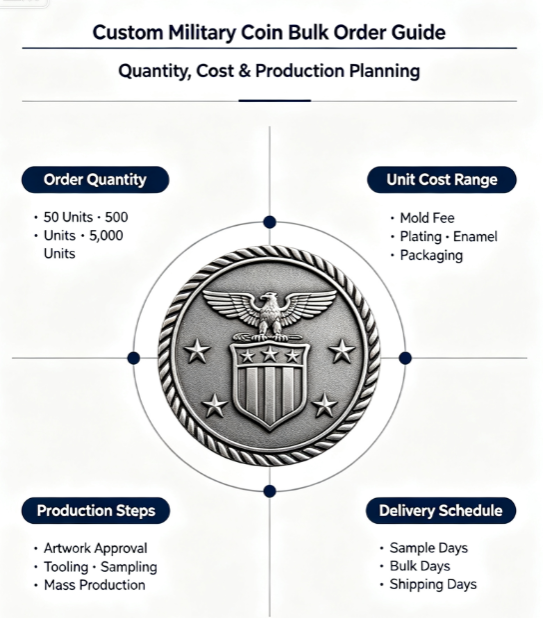
Custom military coins are often designed to recognize military units, deployments, achievements, anniversaries, leadership, training, retirement and special operations. While the front and back usually carry the main artwork, the coin edge provides valuable space for information that may be difficult to fit into the central design.
Edge lettering can turn a standard military coin into a more complete commemorative piece.
Common edge information includes:
- Unit names
- Mottos
- Dates
- Locations
- Operation names
- Rank
- Names
- Serial numbers
- Award titles
- Coordinates
- Short quotations
- Organization names
- Anniversary years
The challenge is choosing information that is short enough to manufacture clearly while still adding meaning.
Quick Guide: What Should Go on a Military Coin Edge?
| Edge Information | Best Application | Recommended |
|---|---|---|
| Unit name | Military unit coins | ★★★★★ |
| Motto | Unit recognition | ★★★★★ |
| Date | Deployment/anniversary | ★★★★★ |
| Operation name | Deployment coins | ★★★★★ |
| Location | Commemorative coins | ★★★★☆ |
| Rank/title | Leadership coins | ★★★★☆ |
| Recipient name | Presentation coins | ★★★★☆ |
| Coordinates | Special commemorative coins | ★★★★☆ |
| Serial number | Limited editions | ★★★★☆ |
| Long quotation | Complex designs | ★★☆☆☆ |
| Website/email | Promotional coins | ★★☆☆☆ |
The most effective edge lettering is generally short, relevant and easy to read.
1. What Is Military Coin Edge Lettering?
Edge lettering refers to text manufactured around the perimeter of a challenge coin or military coin.
Depending on the coin design, the edge may be:
- Flat
- Rope edge
- Reeded
- Oblique
- Smooth
- Lettered
- Numbered
Text can sometimes be:
Raised
or
Recessed
depending on the manufacturing method and design.
For a custom military coin, edge lettering provides an additional information zone without overcrowding the front or back.
2. Why Use Edge Lettering?
A challenge coin has limited surface area.
Suppose a 1.75-inch coin contains:
- Unit emblem on the front
- Aircraft on the back
- Several colors
- 3D relief
- Organization logo
Adding another long sentence to the front can make the design difficult to read.
Edge lettering solves this problem by moving secondary information to the perimeter.
For example:
Front: Unit emblem
Back: Aircraft
Edge: 1ST AIR CAV • 2026 • FORT HOOD
This creates a much cleaner hierarchy.
3. How Much Text Should You Put on the Edge?
There is no universal character limit because it depends on:
- Coin diameter
- Edge width
- Font size
- Font type
- Letter height
- Spacing
- Manufacturing method
- Number of words
However, short phrases are generally easier to manufacture and read.
Instead of:
“This coin is proudly presented to recognize outstanding dedication and service to the unit during the 2026 deployment.”
Use:
OUTSTANDING SERVICE • 2026
The second version is much more suitable for a coin edge.
4. Unit Name
One of the most common uses is the military unit name.
Examples:
101ST AIRBORNE DIVISION
3RD INFANTRY DIVISION
SPECIAL OPERATIONS
1ST BATTALION
If the official unit name is long, consider using an approved abbreviation.
5. Military Unit Designation
You can include:
- Battalion
- Squadron
- Company
- Regiment
- Brigade
- Division
- Wing
- Group
- Flight
- Platoon
For example:
2ND BN • 75TH RGR
or
5TH SQ • 9TH WG
Always verify official abbreviations before manufacturing.
6. Military Motto
A short motto can work particularly well.
Examples:
NO MISSION TOO DIFFICULT
ALWAYS READY
DEEDS NOT WORDS
SERVE WITH HONOR
MISSION FIRST
A motto should normally be short enough to remain legible around the edge.
7. Deployment Information
Deployment coins can use the edge for:
- Operation name
- Deployment location
- Deployment year
- Unit
- Rotation number
Example:
OPERATION FREEDOM • 2026
or:
EUROPE DEPLOYMENT • 2026
This information can make the coin more historically meaningful.
8. Date
Dates are one of the simplest and most useful edge elements.
Examples:
2024–2026
JUNE 2026
EST. 1945
1945–2026
Dates work especially well for:
- Anniversaries
- Retirements
- Deployments
- Unit activations
- Command changes
- Ceremonies
9. Anniversary Information
For an anniversary coin, consider:
75 YEARS OF SERVICE
EST. 1951 • 2026
or:
50TH ANNIVERSARY
The edge can provide the date while the front contains the anniversary emblem.
10. Retirement Coins
Retirement coins often include:
- Name
- Rank
- Years of service
- Unit
- Retirement date
For example:
COL. SMITH • 1988–2026
The front can feature the individual’s emblem while the edge contains service dates.
11. Leadership Coins
Command or leadership coins can use edge lettering for:
- Rank
- Name
- Position
- Command period
Example:
COMMANDER • 2026
or:
COL. JOHN SMITH
This makes the coin more personal without overcrowding the center.
12. Award Coins
For recognition coins, the edge may include:
EXCELLENCE IN SERVICE
OUTSTANDING PERFORMANCE
LEADERSHIP AWARD
MISSION EXCELLENCE
The main design can then focus on the organization’s emblem.
13. Name and Rank
Personalized military coins can include:
CAPT. JOHN SMITH
SGT. MICHAEL JONES
However, if you are producing hundreds or thousands of individually named coins, personalization can add manufacturing complexity and cost.
14. Serial Numbers
Limited-edition coins can use serial numbers such as:
001 / 500
002 / 500
003 / 500
This can make the coins more collectible.
However, sequential numbering requires additional production and quality-control attention.
15. Coordinates
GPS coordinates can create a highly personal commemorative design.
For example:
38.9072° N • 77.0369° W
Coordinates could represent:
- Headquarters
- Training location
- Deployment location
- Historic event location
- Unit origin
Because coordinate text can be relatively long, careful sizing is necessary.
16. Location Names
Instead of coordinates, use a short location:
FORT LIBERTY
FORT CAMPBELL
SAN DIEGO
WASHINGTON, D.C.
The location should be accurate and appropriate for the coin’s purpose.
17. Operation Names
For deployment or commemorative coins:
OPERATION INHERENT RESOLVE
OPERATION ENDURING SENTINEL
Long operation names may require abbreviations or alternative placement because the coin edge has limited space.
18. Aircraft Information
Aviation military coins can use the edge for:
- Aircraft model
- Squadron
- Flight
- Mission
- Year
Example:
F-35A • 421 FS • 2026
This leaves the aircraft illustration as the visual focus of the coin.
19. Ship Information
Navy-related coins can include:
- Ship name
- Hull number
- Deployment
- Squadron
- Date
Example:
USS EXAMPLE • DDG-XX
Always verify official ship naming and designation requirements.
20. Marine Corps Coins
Marine Corps-related coins may use edge lettering for:
- Unit
- Battalion
- MOS-related information
- Deployment
- Motto
- Year
Because many military organizations have official terminology, artwork and wording should be verified before production.
21. Air Force Coins
Air Force coins can use edge lettering for:
- Squadron
- Wing
- Aircraft
- Mission
- Base
- Year
Example:
23 WG • 2026
The front can contain the aircraft or wing emblem.
22. Army Coins
Army coins frequently use:
- Unit designation
- Motto
- Deployment
- Anniversary
- Leadership title
- Date
The edge provides a useful secondary information area.
23. Navy Coins
Navy-related coins can feature:
- Ship name
- Hull number
- Squadron
- Deployment
- Year
- Command title
Keep the lettering concise to maintain readability.
24. Coast Guard Coins
Coast Guard coins may include:
- Station
- Cutter
- Unit
- Mission
- Date
- Motto
For example:
USCG • SEARCH & RESCUE • 2026
25. Space Force Coins
Space-related coins can use the edge for:
- Unit
- Mission
- Year
- Location
- Short motto
Because space-themed artwork can already be highly detailed, edge lettering can provide useful supporting information.
26. Special Operations Coins
Special operations-related coins often use very concise text.
Possible categories include:
- Unit designation
- Mission
- Motto
- Date
- Recognition title
For sensitive organizations or operations, buyers should ensure that all information included on a publicly distributed coin is appropriate for release.
27. Training Coins
Training-related coins can include:
CLASS 26-01
GRADUATION • 2026
LEADERSHIP COURSE
TRAINING EXCELLENCE
This is especially useful when the main face is occupied by an emblem.
28. Graduation Coins
Military graduation coins can use:
CLASS OF 2026
GRADUATION
FORT [LOCATION]
JUNE 2026
The edge can create a clean distinction between the class identity and the central artwork.
29. Recruiting Coins
Recruiting coins can include:
SERVICE • HONOR • DUTY
or:
RECRUITING EXCELLENCE
The wording should match the organization’s approved messaging.
30. Firefighter & First Responder Military-Style Coins
The same edge-lettering principle can be applied to:
- Fire department coins
- Police recognition coins
- EMS coins
- First responder coins
For example:
SERVICE • COURAGE • COMMITMENT
31. Corporate Recognition Coins
Not every challenge coin is military.
Corporate coins may include:
10 YEARS OF SERVICE
LEADERSHIP EXCELLENCE
TEAM 2026
EMPLOYEE OF THE YEAR
This makes edge lettering useful for corporate recognition programs.
32. What Should NOT Go on the Edge?
Avoid unnecessarily long information.
Poor examples include:
“THIS COIN IS PRESENTED IN RECOGNITION OF OUTSTANDING SERVICE AND COMMITMENT TO THE ORGANIZATION”
A shorter version is better:
OUTSTANDING SERVICE • 2026
The edge should support the main design—not compete with it.
33. Font Selection
Font selection is critical.
Good options generally have:
- Clear letter shapes
- Adequate spacing
- Strong contrast
- Simple forms
Avoid extremely decorative fonts when the letters are small.
A beautiful font on a computer screen may become difficult to manufacture at coin scale.
34. Letter Height
The smaller the lettering, the more difficult it can become to manufacture clearly.
Very small lettering can cause:
- Loss of detail
- Poor definition
- Filling problems
- Reduced readability
The manufacturer should evaluate the actual artwork before finalizing the font size.
35. Letter Spacing
Spacing is just as important as font size.
Compare:
UNIT•2026•SERVICE
with:
UNIT • 2026 • SERVICE
The second version is generally easier to visually separate.
36. Use Separators
Useful separators include:
•
|
◆
—
For example:
UNIT • MISSION • 2026
Separators can make circular text much easier to read.
37. Raised vs Recessed Edge Lettering
Edge lettering may be manufactured in different ways.
Raised lettering
Text stands above the surface.
Recessed lettering
Text is cut into the surface.
The choice depends on:
- Coin design
- Tooling
- Edge structure
- Desired appearance
- Manufacturing method
38. Flat Edge vs Lettered Edge
A flat edge is simple and clean.
A lettered edge provides additional information.
For commemorative coins, lettered edges can create a premium appearance.
39. Rope Edge vs Lettered Edge
A rope edge provides decorative texture.
A lettered edge provides information.
If the buyer needs both decorative treatment and text, the manufacturer should evaluate whether the design can accommodate both without becoming overcrowded.
40. Double-Sided Coins
For double-sided military coins, edge lettering becomes particularly useful.
Example:
Front
Unit emblem
Back
Aircraft
Edge
HONOR • DUTY • SERVICE • 2026
This creates a three-layer information hierarchy.
41. 1.5-Inch Coins
A 1.5-inch coin has less available perimeter than larger coins.
Therefore, edge lettering should be:
- Short
- Simple
- Highly legible
Long phrases may be unsuitable.
42. 1.75-Inch Coins
A 1.75-inch coin offers more design space and is one of the more versatile sizes.
It can accommodate:
- Unit
- Motto
- Date
- Short location
with appropriate engineering.
43. 2-Inch Coins
A 2-inch coin provides greater visual area.
It may be suitable for:
- Longer edge text
- Detailed 3D designs
- Multiple information elements
However, more surface area does not automatically mean unlimited text.
44. Edge Lettering and Coin Thickness
Thickness also affects the available edge area.
For example, thicker coins can provide more physical edge surface, but the exact design depends on:
- Edge width
- Edge geometry
- Coin diameter
- Tooling method
45. How Many Words Should You Use?
There is no universal maximum.
However, a useful design principle is:
Use the minimum number of words necessary to communicate the information.
Instead of:
UNIT HISTORY AND SERVICE RECOGNITION 2026
consider:
UNIT SERVICE • 2026
Shorter usually means cleaner.
46. Edge Lettering for Limited Editions
For collectible coins:
EDITION 001/500
can be useful.
Another option is:
LIMITED EDITION • 2026
Serial numbering provides additional collectibility.
47. Edge Lettering for Anniversary Coins
Examples:
50 YEARS • 1976–2026
EST. 1976 • 2026
75TH ANNIVERSARY
This works particularly well when the center design already contains the anniversary emblem.
48. Edge Lettering for Retirement Coins
Examples:
1988–2026 • RETIREMENT
30 YEARS OF SERVICE
HONOR • SERVICE • SACRIFICE
Personal information can be placed on the edge while the front remains visually focused.
49. Edge Lettering for Leadership Coins
Examples:
COMMANDER • 2026
LEADERSHIP • SERVICE • HONOR
COMMAND TOUR • 2024–2026
Keep the wording concise.
50. Edge Lettering for Unit Coins
A strong format is:
UNIT • MOTTO • YEAR
For example:
1ST BN • ALWAYS READY • 2026
This provides three pieces of information without overwhelming the coin.
51. Edge Lettering for Deployment Coins
A practical format is:
OPERATION • LOCATION • YEAR
For example:
DEPLOYMENT • EUROPE • 2026
This provides a clear historical reference.
52. Edge Lettering for Event Coins
Use:
EVENT • DATE • LOCATION
For example:
COMMAND CEREMONY • JUNE 2026
This creates a useful commemorative record.
53. Edge Lettering for Corporate Challenge Coins
Possible formats:
10 YEARS • SERVICE • 2026
or:
LEADERSHIP EXCELLENCE • 2026
Corporate coins can use edge text to communicate recognition without overcrowding the logo.
54. Edge Lettering and Manufacturing Cost
Edge lettering may affect cost because it can require:
- Additional tooling complexity
- More engineering
- More detailed inspection
- Special edge preparation
The cost impact depends on the design and production method.
55. Does Edge Lettering Increase Mold Cost?
It can.
If edge lettering requires additional tooling complexity, the manufacturer may need additional engineering or tooling work.
The exact cost depends on the coin design.
56. Does Edge Lettering Increase Production Time?
Potentially.
Additional detail may require more tooling preparation and inspection.
However, the impact can be relatively small for a straightforward design.
57. Edge Lettering Quality Control
Inspect:
- Letter accuracy
- Spelling
- Character alignment
- Depth
- Spacing
- Missing letters
- Surface consistency
Spelling should be checked before tooling.
Correcting a spelling mistake after the mold is produced can be expensive and time-consuming.
58. The Most Important Rule: Proofread Everything
Before approving the mold:
Check every letter.
Check:
- Unit designation
- Names
- Dates
- Numbers
- Abbreviations
- Locations
- Mottos
A one-character mistake can affect an entire production batch.
59. Who Should Approve Military Wording?
For official military or government-related products, the customer or authorized organization should verify:
- Official name
- Unit designation
- Insignia
- Motto
- Dates
- Abbreviations
The manufacturer should manufacture according to approved specifications rather than independently deciding official wording.
60. Edge Lettering Design Formula
A simple design formula is:
Identity + Meaning + Date
For example:
UNIT + SERVICE + 2026
This is one of the easiest ways to create useful edge lettering.
61. 10 Practical Edge Lettering Examples
Example 1
UNIT • HONOR • 2026
Example 2
SERVICE • DUTY • COMMITMENT
Example 3
EST. 1976 • 2026
Example 4
DEPLOYMENT • 2026
Example 5
CLASS 26-01 • GRADUATION
Example 6
30 YEARS OF SERVICE
Example 7
COMMAND • 2024–2026
Example 8
MISSION • TEAM • EXCELLENCE
Example 9
LIMITED EDITION • 001/500
Example 10
UNIT NAME • LOCATION • YEAR
62. How to Design Edge Text for a 1.75-Inch Coin
For a 1.75-inch coin, begin with the most important information.
Priority:
1. Unit
2. Date
3. Motto
4. Location
If the edge becomes crowded, remove the lowest-priority item.
63. Edge Lettering for a 3D Coin
A 3D coin already contains considerable visual information.
Therefore, the edge should normally remain simple.
A good approach is:
3D front + 3D back + simple edge
rather than:
3D front + 3D back + long edge paragraph
64. Edge Lettering for Antique Finishes
Antique finishes can provide strong contrast between:
- Raised letters
- Recessed areas
- Background
This can make edge text visually distinctive.
65. Edge Lettering for Gold Coins
Bright gold finishes create a premium appearance.
For readability, the manufacturer should carefully consider:
- Letter depth
- Polishing
- Contrast
- Edge background
The same artwork may appear differently under different plating finishes.
66. Edge Lettering for Silver Coins
Silver finishes can provide a clean appearance.
Antique silver can create greater visual contrast between raised and recessed areas.
67. Edge Lettering for Black Nickel Coins
Black nickel can provide a strong modern appearance.
However, small lettering still needs sufficient depth and spacing.
68. Edge Lettering for Military Collectors
Collectors often appreciate information that helps identify:
- Unit
- Year
- Event
- Edition
- Deployment
This can make the coin more historically meaningful.
69. Edge Lettering and Storytelling
A well-designed coin can communicate a story through three layers:
Front
Who
Back
What
Edge
When / Where / Why
This is one of the most effective ways to organize a challenge coin design.
70. What Information Has the Highest Value?
For most military coins, prioritize:
Unit identity
Date
Mission/event
Motto
Location
Recipient
The exact priority depends on the purpose of the coin.
71. What Information Has Low Value?
Avoid using edge space for information that the recipient does not need.
For example:
- Full company address
- Long marketing slogan
- Website URL
- Long description
- Excessive contact information
These elements may be better placed on packaging or promotional materials.
72. Edge Lettering vs Front Text
If text is essential to understanding the coin, place it on the front.
If text is supporting information, consider the edge.
For example:
FRONT: UNIT NAME
EDGE: 2026 • DEPLOYMENT
This hierarchy makes the design easier to understand.
73. Edge Lettering vs Back Text
If the back already contains detailed information, the edge can remain minimal.
Avoid placing too much information on every surface.
Good design requires visual hierarchy.
74. How Manufacturers Evaluate Edge Text
A manufacturer should check:
- Coin diameter
- Edge circumference
- Edge width
- Font height
- Letter thickness
- Character spacing
- Tooling feasibility
The final recommendation should be based on the actual production drawing.
75. Why the Circumference Matters
A larger coin has a longer circumference.
Mathematically:
Circumference = π × Diameter
For a 1.5-inch coin:
≈ 4.71 inches
For a 1.75-inch coin:
≈ 5.50 inches
For a 2-inch coin:
≈ 6.28 inches
This demonstrates why larger coins can accommodate more edge information.
However, usable lettering space is less than the total circumference because spacing and margins are required.
76. Edge Lettering and Character Count
Suppose a coin has approximately 5.5 inches of circumference.
The manufacturer still needs to account for:
- Character width
- Spacing
- Margins
- Separators
- Letter depth
Therefore, character count should be determined from the actual font and production drawing—not simply from circumference.
77. Example: 1.75-Inch Coin
Suppose the edge reads:
UNIT • SERVICE • 2026
This is relatively short.
Adding:
UNIT • SERVICE • DEPLOYMENT • LOCATION • 2026 • COMMAND
may create unnecessary crowding.
A better solution could be:
UNIT • DEPLOYMENT • 2026
78. Edge Lettering and Accessibility
Clear text benefits:
- Older recipients
- Collectors
- Event participants
- Military organizations
- Corporate award recipients
Readable lettering is more valuable than decorative complexity.
79. Common Edge Lettering Mistakes
Mistake 1: Too much text
Mistake 2: Tiny font
Mistake 3: Wrong spelling
Mistake 4: Incorrect date
Mistake 5: Poor spacing
Mistake 6: Too many abbreviations
Mistake 7: Using an unsuitable font
Mistake 8: Adding unnecessary marketing information
Mistake 9: Not checking the digital proof
Mistake 10: Changing wording after tooling
80. Final Design Recommendation
For most custom military coins, start with:
UNIT + MOTTO + DATE
If there is additional room:
LOCATION
or
MISSION
can be added.
This creates a useful balance between information and visual clarity.
Frequently Asked Questions
1. What is military coin edge lettering?
It is text manufactured around the perimeter of a custom military coin.
2. What should I put on a coin edge?
Unit names, mottos, dates, locations, mission names and short recognition phrases are common choices.
3. Can I put a name on the edge?
Yes, if the design provides sufficient space.
4. Can I put a military unit name on the edge?
Yes.
5. Can I put a motto on the edge?
Yes.
6. Can I put a date on the edge?
Yes.
7. Can I put coordinates on the edge?
Yes, if the text can be manufactured clearly.
8. Can I put a serial number on the edge?
Yes.
9. Can edge lettering be raised?
Yes, depending on the manufacturing method.
10. Can edge lettering be recessed?
Yes.
11. Can I use a different font?
Usually, but the font must remain manufacturable.
12. Is there a maximum number of characters?
There is no universal maximum.
13. Does coin size affect edge lettering?
Yes.
14. Is 1.5 inches suitable for edge lettering?
Yes, but shorter text is generally preferable.
15. Is 1.75 inches suitable?
Yes, it offers more design flexibility.
16. Is 2 inches better for long lettering?
It provides more circumference, but text should still remain concise.
17. Does coin thickness matter?
Yes, particularly for edge construction.
18. Does edge lettering increase cost?
It can.
19. Does edge lettering increase production time?
Potentially.
20. Does 3D design affect edge lettering?
Yes, because the overall design becomes more complex.
21. Can double-sided coins have edge lettering?
Yes.
22. Can military coins have both rope edges and lettering?
Depending on the design, but the manufacturer should confirm feasibility.
23. Can I put a long quotation on the edge?
It is possible in some designs, but generally not recommended.
24. What is better than a long quotation?
Use a short phrase that communicates the main idea.
25. Can I put a unit abbreviation on the edge?
Yes.
26. Should I use abbreviations?
Only when the abbreviation is clear and officially appropriate.
27. Can I put the year on the edge?
Yes.
28. Can I put two dates on the edge?
Yes, such as service years.
29. Can I put a deployment year on the edge?
Yes.
30. Can I put a location on the edge?
Yes.
31. Can I put a base name on the edge?
Yes, provided the wording is appropriate.
32. Can I put an aircraft model on the edge?
Yes.
33. Can I put a ship name on the edge?
Yes.
34. Can I put a hull number on the edge?
Potentially, depending on available space.
35. Can I put a rank on the edge?
Yes.
36. Can I put a recipient’s name on the edge?
Yes.
37. Can I put a retirement date on the edge?
Yes.
38. Can I put years of service on the edge?
Yes.
39. Can I put an anniversary on the edge?
Yes.
40. Can I put “50th Anniversary” on the edge?
Yes.
41. Can I put “Class of 2026” on the edge?
Yes.
42. Can I put a graduation date on the edge?
Yes.
43. Can I put an award title on the edge?
Yes.
44. Can I put “Outstanding Service” on the edge?
Yes.
45. Can I put a company name on the edge?
Yes.
46. Can corporate challenge coins use edge lettering?
Yes.
47. Can firefighter coins use edge lettering?
Yes.
48. Can police recognition coins use edge lettering?
Yes.
49. Can EMS coins use edge lettering?
Yes.
50. Can first responder coins use edge lettering?
Yes.
51. Can edge lettering be used on medals?
Similar perimeter lettering can be used on some medal designs, depending on the structure.
52. Can lapel pins have edge lettering?
Some larger or specially designed pins can accommodate perimeter text.
53. Can badges have perimeter text?
Yes, depending on the badge design.
54. Is edge lettering difficult to manufacture?
It requires accurate tooling and sufficient space.
55. What is the biggest edge-lettering problem?
Usually overcrowding or excessively small lettering.
56. Should I approve a mockup before production?
Yes.
57. Should I proofread the edge text?
Absolutely.
58. Can the factory correct spelling after mold production?
It may require tooling modification or a new mold.
59. Should I check dates?
Yes.
60. Should I check unit abbreviations?
Yes.
61. Should I check names?
Yes.
62. Should I check serial numbers?
Yes.
63. Should I use all capital letters?
Capital letters can improve visibility, but the final choice depends on the font.
64. Should I use bold lettering?
A suitable bold font can improve readability.
65. Is decorative script a good choice?
Usually not for very small edge text.
66. What is the best font for edge lettering?
A clear, simple font is usually the safest option.
67. Does enamel go on the edge?
Some designs may incorporate color, but conventional edge lettering is often metallic.
68. Can edge lettering be plated differently?
Depending on the design, selective finishing may be possible.
69. Can edge text be polished?
Yes, depending on the manufacturing design.
70. Does antique plating improve edge visibility?
It can create contrast between raised and recessed areas.
71. Can gold plating make small text harder to read?
Depending on the surface and lighting, it can affect visual contrast.
72. Is antique silver good for military coins?
It is a common aesthetic choice, but the appropriate finish depends on the design.
73. Does edge lettering work with 3D coins?
Yes.
74. Does edge lettering work with cut-out coins?
Yes, if sufficient perimeter material remains.
75. Does edge lettering work with spinning coins?
It can, but the moving construction requires additional engineering.
76. Can edge lettering identify a limited edition?
Yes.
77. Can edge lettering include “001/500”?
Yes.
78. Can edge lettering include a website?
Technically possible on some designs, but usually not the best use of limited space.
79. Should I put an email address on the edge?
Usually not unless the coin has a promotional purpose.
80. Should I put a phone number on the edge?
Usually not for commemorative military coins.
81. What is the best use of limited edge space?
Identity, date, mission and short recognition information.
82. Should the edge repeat the front design?
Usually, no. Use the edge for complementary information.
83. Can the edge tell the story of the coin?
Yes.
84. What should the front contain?
Usually the primary visual identity.
85. What should the back contain?
Supporting artwork, emblem, message or imagery.
86. What should the edge contain?
Secondary identifying information such as date, unit, motto or location.
87. Is edge lettering useful for anniversary coins?
Yes.
88. Is edge lettering useful for retirement coins?
Yes.
89. Is edge lettering useful for deployment coins?
Yes.
90. Is edge lettering useful for leadership coins?
Yes.
91. Is edge lettering useful for graduation coins?
Yes.
92. Is edge lettering useful for collectible coins?
Yes, especially for edition numbers.
93. Can edge lettering make a coin look more premium?
It can enhance the perceived detail when properly engineered.
94. Can too much edge text make a coin look worse?
Yes.
95. What is the most important design principle?
Prioritize readability over the amount of information.
96. Should I ask the manufacturer for technical advice?
Yes, especially for small lettering.
97. Should I send vector artwork?
Vector artwork is generally preferable for manufacturing preparation.
98. Should I specify the desired coin size?
Yes.
99. Should I specify thickness?
Yes.
100. What is the best overall edge-lettering strategy?
Use short, meaningful information—typically unit identity, motto, date, mission or location—and confirm the final lettering with the manufacturer before tooling.
Final Takeaway
The best military coin edge lettering is not the longest lettering. It is the lettering that adds useful information without making the coin difficult to read.
A strong design hierarchy is:
Front → Primary identity
Back → Main story or imagery
Edge → Unit, motto, date, mission or location
For a typical custom military coin, a format such as:
UNIT • MISSION • 2026
or:
UNIT • SERVICE • ANNIVERSARY
can provide meaningful information while preserving a clean design.
When preparing a custom military coin, always confirm coin diameter, thickness, edge style, font, character size, spacing, wording and manufacturing feasibility before approving the mold.
For custom challenge coins, military coins, medals, police badges, lapel pins and other metal recognition products, ChallengeCoinBadges can assist with custom artwork, digital mockups, tooling and production. Contact sales@challengecoinbadges.com for a project-specific recommendation.